Massachusetts Said No to Smaller House Lots. What Does That Mean for Boston Housing?
Boston voted Yes by more than 66,000 votes, but voters elsewhere delivered a larger No margin. Here's how the statewide result happened, who opposed it, and what homebuyers should expect next.
In this article
If you have spent a Sunday scrolling through starter-home listings in Medford, Malden or the suburbs beyond the Orange Line, you have probably wondered why so many houses are either very expensive or much larger than you need. Sometimes the price of land is part of the answer. Sometimes local zoning means a house cannot be built on a modest-size lot at all.
That was the problem Question 7 tried to address. But after a razor-thin vote and three days of counting, the Associated Press called the November 3 ballot question for No on Friday. Unofficial returns with roughly 99% of expected votes counted showed 50.6% against and 49.4% in favor, a margin of 32,941 votes in the updated AP snapshot out of more than 2.5 million yes-or-no votes. The result is a projection, not state certification.
For Greater Boston households, the decision is neither an immediate rent increase nor the disappearance of a home that already exists. It means one proposed way of creating additional single-family housing did not become law. Local zoning restrictions remain, and other routes to housing development continue.
How Boston voted Yes, but Question 7 lost statewide
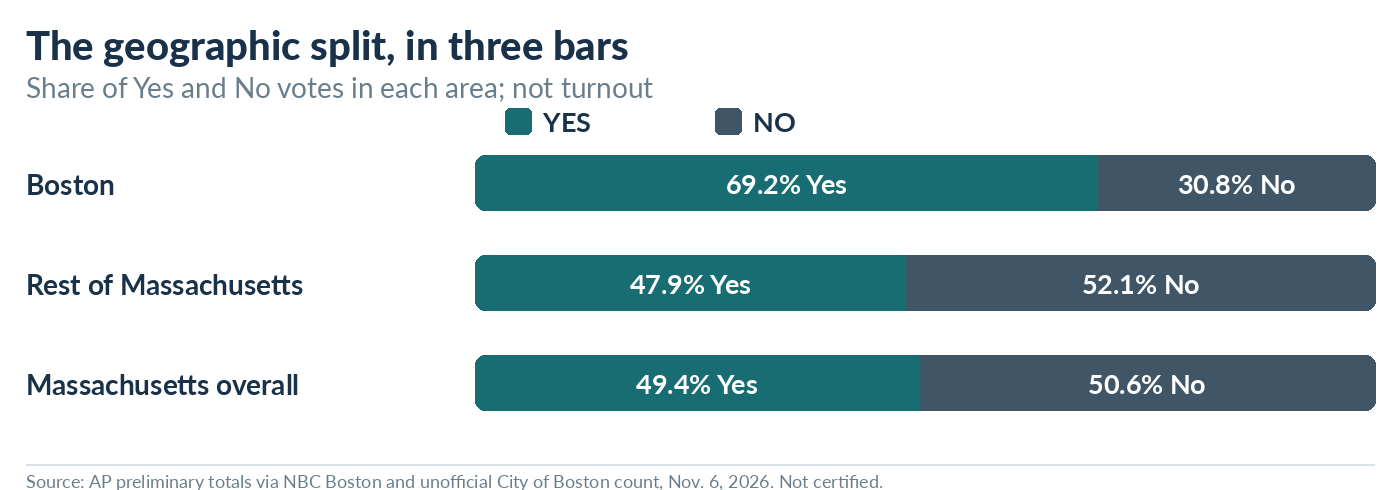
The short version: Boston voted strongly for Question 7. Voters in the rest of Massachusetts, taken together, narrowly voted against it. Because the rest of the state cast many more votes, its No margin was big enough to outweigh Boston's Yes margin, leaving a 32,941-vote statewide No lead in the cited preliminary count.
How the votes added up
| Where votes were cast | Yes votes | No votes | Margin |
|---|---|---|---|
| Boston | 119,998 | 53,286 | Yes by 66,712 |
| Rest of Massachusetts | 1,135,597 | 1,235,250 | No by 99,653 |
| Statewide total | 1,255,595 | 1,288,536 | No by 32,941 |
Vote totals from the November 6 AP snapshot (about 99% reporting), with Boston's city-reported unofficial totals. "Rest of Massachusetts" equals statewide totals minus Boston; the statewide result has been called, not certified.
The same result, shown as vote shares
Why Boston readers should care: The city's own zoning code was exempt from the proposal because Question 7 would have amended Chapter 40A. Still, families priced out of Boston often search across city lines. A change in places such as Medford or Arlington could have opened additional potential housing choices; now their local rules remain the starting point. No specific change in rents or sale prices can be attributed to this vote.
This is a large difference in how residents approached the statewide rule, but it should not be read as a verdict on any individual voter's motive. A resident may worry about affordability, a neighbor may worry about utilities, and both may acknowledge a housing shortage.
Who voted No? The pattern is local, not simply partisan
The contrast was bigger than a city-versus-suburb slogan. In addition to Boston, preliminary results showed strong Yes support in nearby Somerville (about 76%), Cambridge, Medford, Watertown, Brookline and Arlington. Yet the No side prevailed in many smaller and outer-ring communities, including Wellesley, Duxbury and Marshfield; roughly 75% of Rehoboth voters opposed the measure. A town can vote one way for many different reasons, so location by itself is not proof of any resident's motive.
In the Boston Globe's reporting, William Giuffre, a Wakefield resident, described his No vote in terms of giving towns control over land use. The official ballot pamphlet's opposition argument was written by Adam Chapdelaine of the Massachusetts Municipal Association, which represents municipal officials. Their central objections concerned state preemption of local zoning, infrastructure capacity, and the absence of a guarantee that new homes would be affordable. The proposal did require public water and sewer access, but that would not resolve every town-wide capacity concern.
Who bankrolled the No side? The answer is unusual
There was no registered ballot-question committee campaigning against Question 7 in the latest Office of Campaign and Political Finance committee records reviewed for this article. That means there is no disclosed largest donor to a registered No committee to identify. It does not mean the opposition had no organization, communications, staff time or influence. The Massachusetts Municipal Association argued against the measure publicly and wrote the official No argument. The absence of a dedicated committee cannot tell us how much other forms of advocacy cost.
The Yes side, meanwhile, drew substantial reported financial backing. OCPF-derived donor records identify the Greater Boston Real Estate Board ($350,000) and the Massachusetts Association of Realtors PAC ($350,000) as the largest listed organizational donors. The Welcoming Neighbors Network ($250,000), the Massachusetts Association of Realtors itself ($150,000), and Airbnb ($105,000) were also named. Those are contributions to supporting committees, not proof that each dollar was spent on a particular ad or changed a vote.
As of its November 6 update, the OCPF-based MassVoter tracker recorded no committee on the No side and about $468,000 in expenditures specifically attributed to Question 7 among supporting committees. The same site lists substantially larger fundraising totals across 2025 and 2026 for those committees. These are different accounting measures; a committee can raise money across multiple questions, and its total receipts are not equal to spending on Question 7. The figures may be revised in later filings.
Why was it nearly a tie? Four tensions the vote exposed
1. A regional divide. Boston and dense inner-ring communities voted strongly Yes, while enough other municipalities voted No to overcome those margins. The state total was not a referendum on Boston's zoning alone, and it was not a simple tally of suburbs against cities.
2. Homes versus local authority. For supporters, reducing large minimum-lot rules created potential starter-home supply. For opponents, the state was overriding local planning on issues including traffic, infrastructure and neighborhood design. Both arguments could resonate with a homeowner who wants more options for their children but is also concerned about development nearby.
3. A promise, but no price cap. A 5,000-square-foot minimum might have opened more legal building sites, but the ballot language did not require any finished house to sell below a particular price. That was an important objection for voters who wanted evidence the reform would actually yield attainable homes.
4. An unfamiliar, technical question. The Boston Globe reported that some voters were confused about what 5,000 square feet meant and what the proposal would override. Pre-election surveys also disagreed: a UMass Amherst/WCVB poll reported 65% Yes and 21% No among likely voters, while a Suffolk/Globe poll showed approximately 41% Yes and 40% No. Different samples and timing matter. The polls do not establish that confusion caused the eventual result.
Under one reported-count snapshot, about 16,500 voters switching from No to Yes, with all other votes unchanged, would have been enough to reverse the statewide lead. That illustrates how close it was, but does not show why anyone voted as they did. There is no representative post-election voter survey here establishing a single cause.
What a Yes vote could actually have opened up
The official ballot proposal would have protected a single-family home in a residential district if its lot had at least 5,000 square feet of area, 50 feet of frontage, and public water and sewer access. For a qualifying home, a town generally could not prohibit the use or require discretionary zoning permission simply because of larger local minimum-lot rules. Towns would still have been able to apply reasonable requirements involving setbacks, height, bulk and short-term rentals.
Picture a hypothetical 7,500-square-foot parcel in a suburb whose zoning normally demands 10,000 square feet for a new single-family house. Under the proposal, the state rule might have removed that particular zoning obstacle. But that is not the same as automatically authorizing a subdivision, approving a house plan, arranging utilities or meeting building codes. Whether an actual parcel qualified would depend on its boundaries, frontage, access and other rules.
The proposal would not have legalized multifamily buildings on every small lot, and it imposed no affordable-sale-price requirement. A smaller lot can make a smaller house financially feasible in some cases, but it can also produce a high-priced new house. The distinction between legal permission and an attainable listing is central to judging the policy.
How many homes might have followed? There was no single answer
The Legalize Starter Homes campaign estimated the proposal could lead to 2,200 to 5,700 net new homes per year. Researchers at Tufts University's Center for State Policy Analysis used local zoning information and development assumptions to reach a far more cautious midpoint of 750 per year, with a plausible range of 350 to 1,200. These were pre-election scenarios, not permits or promised construction.
Tufts estimated roughly 200,000 parcels could have gained new construction options, while emphasizing that many would never be redeveloped. Its model suggested the biggest increase would have occurred in suburban communities, especially around Boston where sewer infrastructure and potentially divisible lots overlap. The state's broader housing plan estimates a need for 222,000 additional homes by 2035. A reform adding 750 annually would not have solved that shortage by itself, but it could have widened the menu of possible projects.
What real residents, builders and local officials said
The Boston Globe interviewed Bill Tuttle, a retired city planner and West Roxbury resident, who supported Question 7 because he wanted smaller homes to be possible in the suburbs. Separately, the Globe spoke to William Giuffre of Wakefield, who opposed shifting zoning authority away from towns. These reported individuals illustrate competing concerns, not a representative survey. Boston Dwelling did not interview them.
The Home Builders & Remodelers Association of Massachusetts argued before the election that requiring more expensive land per house makes small homes harder to finance. After the vote, the group's government affairs chair, Mike Travaline, told Realtor.com he saw continued resistance to new building as an obstacle. The association supported the change, so its position is advocacy from an industry stakeholder, not an independent prediction that a buyer would have saved a particular amount.
On the other side, Adam Chapdelaine, executive director of the Massachusetts Municipal Association, said in a post-election statement that the state-level mandate lacked adequate local and affordability safeguards. Municipal officials pointed to water and sewer capacity and the value of local land-use review. Meanwhile, Jesse Kanson-Benanav of Abundant Housing Massachusetts, which supported the proposal, described the narrow defeat as evidence of substantial public support. Those statements help explain the competing policy priorities, without establishing which approach would produce more completed, affordable homes.
Governor Maura Healey and Boston Mayor Michelle Wu both supported Question 7. Their endorsements did not change the result, and the rejection does not automatically repeal the housing initiatives their administrations are pursuing. Boston Dwelling did not interview any of these residents or officials; the remarks above were collected and attributed to their original reporting and statements.
Now that No won, what actually happens?
Local minimum-lot requirements remain the starting point. Someone hoping to build a house on a 5,000-square-foot lot in a town that requires more space cannot rely on Question 7 for new statewide protection. That does not mean every such parcel is illegal to build on. Existing lawful lots, grandfathering rules, local variances and community-specific zoning can produce different answers; the facts of the property matter.
Communities can still change their own rules. Town meetings, city councils and planning boards can consider amendments that permit more small homes. The vote did not prohibit reform at the municipal level. It did, however, leave those decisions with the existing local and state framework, instead of creating the particular state-backed entitlement contemplated by Question 7.
Other state housing policies remain. The MBTA Communities law still requires 177 covered municipalities to establish qualifying multifamily zoning districts, and Massachusetts' statewide accessory dwelling unit framework remains in place outside Boston. The state reported 2,084 approved ADUs since the start of 2025 through June 2026, not 2,084 completed homes. Neither policy is the same as a new right to build a standalone single-family house on a separately subdivided 5,000-square-foot lot.
What about the eight other ballot questions?
All nine outcomes have now been called by the AP. Only three other questions have particularly plausible connections to how housing or neighborhood decisions may unfold:
Question 5, No: Voters rejected a change to the state's tax-revenue limit and rebate formula. Existing rules remain. That does not mean rental-assistance budgets automatically grow or shrink; future appropriations still matter.
Question 1, Yes: Voters supported expanding public-records coverage to much of the governor's office and Legislature, subject to significant exceptions and implementation. For residents following housing funding or state decision-making, additional access to certain administrative records may become useful. It is not a promise that all policymaking correspondence becomes public.
Question 6, Yes: Voters supported creating a conservation fund backed by certain existing tax revenues, subject to legislative appropriations. It could affect future parks, green space and land-conservation projects. The proposal also calls for guidance to coordinate conservation with affordable-housing development. It does not itself approve or block a particular housing project.
| Question | AP-called result | Plain-language subject |
|---|---|---|
| 1 | Yes | Expand certain state public records access |
| 2 | Yes | Allow public defenders and CPCS employees to bargain collectively |
| 3 | No | Keep existing party primary framework |
| 4 | Yes | Enable Election Day voter registration under future rules |
| 5 | No | Keep current state revenue-limit and rebate framework |
| 6 | Yes | Create Nature for All conservation fund, subject to appropriation |
| 7 | No | Do not create new statewide smaller-lot building protection |
| 8 | No | Do not repeal recreational marijuana sales legalization |
| 9 | Yes | Retain the existing 2024 firearms law |
All outcomes are AP projections as of November 6, 2026, not state-certified.
What should you do with this information?
If you are trying to buy: Ask the local planning or building office about a specific parcel's minimum area, frontage, legal lot status, utility availability and subdivision requirements. A listing's lot size is not proof that another house can be built there. Keep watching for municipal zoning changes, and compare actual sale prices rather than assuming "starter" means inexpensive.
If you rent: No new state lot-size right takes effect because of this vote, and your lease does not change. More housing choices could still come from newly approved apartment projects, ADUs and other local reforms. Follow building permits and homes delivered, not just announcements of theoretical zoning capacity.
If you already own a home: Do not count on dividing your backyard into a new building lot because of Question 7; nor should you assume a nearby property suddenly gained that right. Before spending money on plans, have an actual property's zoning and title constraints checked.
The central lesson is less dramatic than a Yes-or-No headline: Massachusetts did not adopt this particular shortcut to more single-family lots, but the cost of living and the need for additional homes did not disappear. The next story to watch is what towns and developers actually do with the laws they have, and whether those decisions create homes at prices residents can manage.