More homes, smaller yards: Could Question 7 give Greater Boston buyers more options?
Massachusetts voters will decide whether qualifying smaller lots can accommodate single-family homes. Here's what that could mean for your search, and why Boston city is different.
By Boston Dwelling · Published · 4 min read
You want a house, but you don’t necessarily want a huge yard to mow or pay for. Could a change in zoning make that search easier?
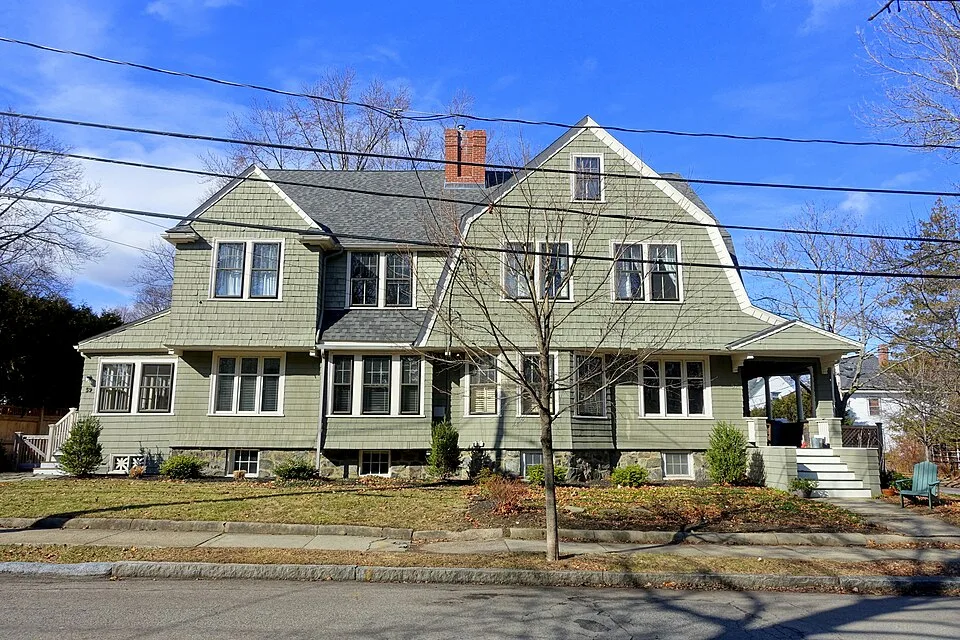
A house in Arlington, photographed February 3, 2020. Neighborhood illustration; this property's lot size, eligibility and sale availability have not been assessed. Photo: Daderot · Source: Wikimedia Commons · CC0 1.0 · Resized for web; preview thumbnails may be cropped
That is the household question behind Massachusetts’ Question 7, on the November 3 ballot. It would make single-family homes easier to build on qualifying smaller lots. With early voting beginning October 17, this is a useful moment to look past the campaign’s ‘starter home’ shorthand and ask what the proposal would deliver.
First, a crucial local distinction: it would not change zoning inside the City of Boston. It amends Chapter 40A, the state zoning law that excludes Boston. The relevance for Bostonians is regional, particularly for people considering a move to a surrounding community.
What would change on a lot?
The proposal covers districts allowing residential uses. A qualifying lot must have at least 5,000 square feet of land, 50 feet of street frontage, and access to public water and sewer. Frontage is the property’s boundary along the street, not the width of its driveway.
For scale, a hypothetical rectangular lot measuring 50 feet by 100 feet has 5,000 square feet. That describes the land, not the house’s floor area or permitted footprint.
The measure would remove special permits and other discretionary zoning approvals for the qualifying use. Reasonable local restrictions, including setbacks and building height, could remain. Buyers would still need to investigate the particular property and its applicable requirements.
A smaller lot does not come with a smaller price tag
The proposed text sets no sale-price cap, first-time-buyer restriction or maximum house size. A home permitted under it would not automatically be income-restricted housing.
For someone who prefers a manageable yard, that distinction matters. A house on less land might suit your life better even if its asking price still exceeds your budget. Conversely, a builder could put an expensive home on a qualifying lot.
Think about the costs a new home must cover: land, design, materials, labor and financing. Changing one zoning requirement does not specify those costs or what the eventual buyer will pay. That is why the useful shopping question is ‘What homes actually get built, at what prices?’ rather than ‘Did the ballot question pass?’
If you are deciding whether to renew a lease or buy this fall, treat this as a possible future source of options. It does not produce a listing you can tour today.
How much housing might it add?
Tufts University’s Center for State Policy Analysis estimates roughly 750 additional homes annually if Question 7 passes, with a plausible range of 350 to 1,200. These are statewide modeling estimates, summarized October 5, not counted apartments or homes already under construction.
How many additional homes? A wide range, not a promise.
Massachusetts · Observed Estimates summarized October 5, 2026; conditional on Question 7 adoption · Illustration / estimate · Values in homes/year
Lower end of plausible range
Central estimate
Upper end of plausible range
Show the exact values
| Category | Value |
|---|---|
| Lower end of plausible range | 350 homes/year |
| Central estimate | 750 homes/year |
| Upper end of plausible range | 1,200 homes/year |
Tufts cSPA estimates of additional homes per year if Question 7 passes. This plausible range is not a statistical confidence interval, observed construction or available listings. Estimates are statewide, not counts for Greater Boston.
Source: Tufts University / Tufts Now, Your Guide to the 2026 Massachusetts Ballot Questions (October 5, 2026)
The wide range is part of the story. Permission to build has to turn into a viable project, then construction, before anyone can move in. The estimate does not tell us how many homes would be built in Arlington or Medford, what they would cost, or when a particular buyer would find one.
The neighborhood question goes beyond the lot line
Supporters argue that large minimum lots shut out more modest housing. Opponents argue that a statewide rule reduces local control over planning and infrastructure. Those are competing campaign arguments, not guarantees about the outcome.
Residents have practical reasons to care about both the opportunity and the implementation. More places to live could help people remain near family or work. Each project also raises ordinary questions about drainage, utility service, construction access and the way a building fits its neighbors.
A useful test for any housing proposal is whether it makes viable homes easier to build while making the remaining rules clear. For buyers, clarity matters: a theoretical building opportunity is difficult to budget around if nobody can explain what is permitted on the actual parcel.
Put it to use
- Check the municipality first. Question 7 would not rewrite Boston city zoning; elsewhere, confirm the lot’s zoning, frontage and water/sewer access before assuming eligibility.
- Keep your search grounded in actual homes and your full budget. Neither passage nor a 5,000-square-foot lot guarantees an affordable purchase.
- Read the official question and both sides’ arguments before voting. A yes vote adopts the proposal; a no vote leaves the relevant law unchanged. Early voting runs October 17-30; Election Day is November 3.