Does the MBTA Communities Law Actually Put New Apartments Near Trains?
The early numbers suggest a surprising gap between allowing apartments and making them easy to reach by transit. Here's what that means in Braintree, Medford and the neighborhoods where you live.
By Boston Dwelling · Published · 8 min read
A new apartment outside Boston might sound like a good trade: more space for the money, with the T still close enough for the trip to work. If your town says it has approved housing under the MBTA Communities law (opens in a new tab) , you might expect the buildings to be concentrated near stations.
But a January 2026 study by Boston Indicators found that only 30% of the homes in its development pipeline with measured station distances were within half a mile of a train stop . Roughly 70% were farther away, even before accounting for the twists of an actual walking route.
That does not mean the law has failed, or that the other homes are poorly located. It does mean the phrase “MBTA Communities” tells you less about your eventual commute than you might think. And many of these homes are still proposals, not available apartments.
In Braintree, one crossing could change an entire commute
At 10 Plain Street , Braintree's Planning Board approved a redevelopment of the former Armstrong industrial site for 752 apartments in March. The town says the plan includes 76 income-restricted homes , new public paths and sidewalk improvements. It is one of the largest projects associated with this zoning reform, and it has not been verified as finished or leasing.
The project also illustrates something a rent listing might never explain. In a March council record, Braintree officials asked the MBTA to reconsider a possible restriction on pedestrian access at the nearby Armstrong Cork rail crossing. The council argued that losing the shortcut could make the trip to a bus stop and South Braintree Square businesses more than five times longer .
For a future resident, the outcome affects whether a bus ride, a quick errand or a car-free evening is genuinely easy. That is why housing and transit must be evaluated together, not as two unrelated announcements.
What the 70% figure actually means
Boston Indicators examined a January 12, 2026 snapshot of 102 projects containing 6,898 homes across 34 communities . After accounting for existing homes, the net increase would be an estimated 6,804 units. The report had station-distance classifications for 6,806 homes , leaving 92 out of that particular calculation.
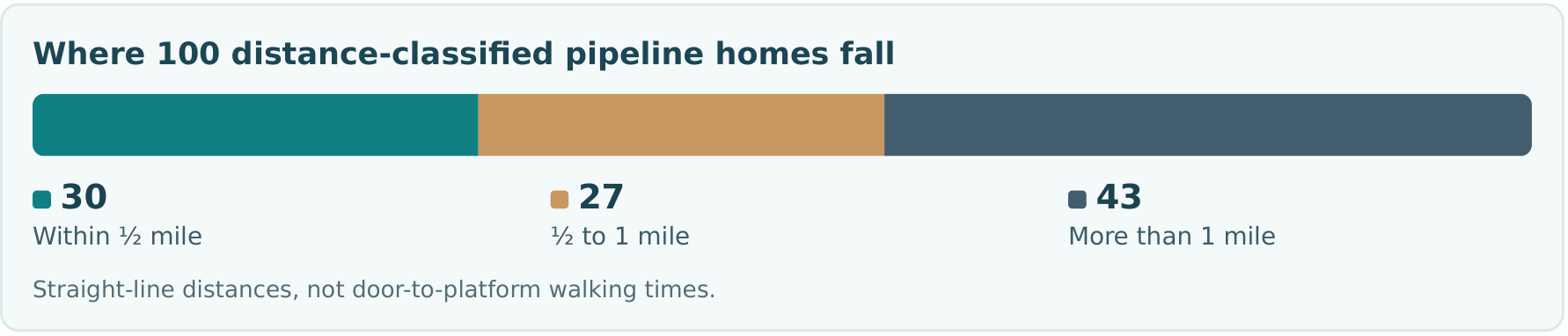
More surprisingly, about 60% of projects but only 30% of homes were inside the half-mile radius. Small projects were often close to rail; some larger projects were farther away. The report also found that 19 large projects accounted for roughly 77% of all 6,898 pipeline homes . One Braintree project by itself represents about 11% of that entire early pipeline.
Those big numbers are useful but fragile. One 752-apartment redevelopment can shift the regional total substantially, yet an approval still depends on financing, construction and eventual legal occupancy. The report's detailed project-size table also contains a small mismatch with its summary totals, which we disclose below rather than conceal.
Why didn't the law require every home to be beside a station?
The law requires 177 MBTA-served municipalities outside Boston to allow qualifying multifamily housing as of right in at least one district, with a minimum overall density of 15 units per acre. “As of right” removes a discretionary zoning decision for the basic residential use, not building permits, financing hurdles or safety inspections. Boston is not among the 177 communities covered by this mandate.
Here is the part many readers may not know: 82 of those communities had no developable station area, and another 14 had fewer than 100 developable acres near stations. Under the state's implementation rules, those 96 communities could locate their qualifying districts elsewhere in town. The remaining 81 faced varying transit-location requirements. Not one was required to put 100% of its zoning capacity beside a station.
That distinction matters. A town without a convenient rail stop can still choose a walkable center with bus service, shops and daily necessities. Boston Indicators points to Bedford , which placed its district in a town-center area rather than beside a train station. A good location can be transit-friendly without being train-adjacent. The question is whether the sidewalks, service and destinations genuinely support daily life.
The same law can create very different neighborhoods
| Place | Early-stage homes | What readers should watch |
|---|---|---|
| Braintree | 752 | Large former-industrial-site redevelopment, site plan approved. Actual pedestrian access and construction delivery remain important. |
| Medford | 248 | A seven-story proposal at 10-20 Revere Beach Parkway near Wellington. Look for final approvals, the real Orange Line walking route and leasing details. |
| Newton | 15 projects | Smaller multifamily and preservation-led projects: 158 proposed or in-progress homes, including about 135 net additions in the January study. A different model from a large tower. |
These figures represent different project scales and stages, not a ranking of completed homes.
These figures represent different project scales and stages, not a ranking of who has built the most. Newton's small additions can preserve existing buildings, while Braintree's large site might add more homes at once. Neither approach replaces the need for a continuous pipeline of viable projects.
Across 141 municipalities examined by the researchers, the new qualifying multifamily districts covered only slightly more than 1% of land area . Even if every identified pipeline home were built, the total would increase the housing stock of the covered municipalities by less than 1% . That is progress worth following, but not a solution on its own. As researcher Amy Dain told WBUR in January, “If it weren't for MBTA Communities zoning, most of these projects would not be possible.”
Why a new zoning district can sit unchanged for years
There is another number worth understanding: zoning capacity . Under the state's calculation, a 50-acre district allowing an average of 15 homes per acre can have a theoretical capacity of 750 homes . That does not mean the town has approved 750 apartments or that developers will build them. It is a model of what could fit under the zoning if parcels redeveloped to their permitted capacity.
Think about a block with a lived-in triple-decker, a grocery store and a successful medical office. New zoning may allow larger buildings on those lots, but the existing owners may have no reason to sell or demolish anything. If financing costs, construction costs or rents make the numbers unattractive, even a vacant parcel may stay vacant. That is why developers, not simply zoning maps, determine which sites actually reach construction.
The research highlights that some communities met state benchmarks by covering small sections of town or land already used efficiently. Other towns, including Bedford, deliberately included low-rise commercial and residential parcels with redevelopment potential. Both may be legally compliant, but the pipeline of real projects can be very different. This is an explanation of the incentives, not a finding that a specific owner is holding back homes.
What about rents and affordable apartments?
Braintree's 752-home approval includes 76 income-restricted apartments, according to the town, but no verified rent schedule or leasing date is available from the records used for this article. Ten percent set aside on paper is not the same as ten percent of new apartments available to apply for today. In another project the unit mix, income bands, application process and actual rents could be quite different.
When neighbors hear that a project is “affordable,” the practical questions are: Affordable to households earning how much? How many bedrooms? What recurring fees are extra? How will households apply, and when? Those details are usually more helpful to prospective residents than a single large headline unit count.
How to tell whether a local housing announcement is real progress
The phrase “zoned for 1,000 homes” is not the same as “1,000 homes are coming next year.” Residents can track projects through four distinct stages:
- Zoning adopted. A town has changed what may legally be proposed. No particular owner has to build.
- Project filed or approved. There is an actual address, a developer and a plan. Conditions, financing and construction timing may still be unresolved.
- Building permit and construction. Work can begin, but a ground-breaking is not an occupancy date.
- Completed and legally occupied. Only now can we count finished homes; a renter still needs to confirm price and actual availability.
Your five-minute neighborhood check
Start with the state district atlas (opens in a new tab), not a headline. Find your municipality's MBTA Communities zoning districts and identify the exact street or parcel. Next, open your city's planning-board agenda, applications or permit records to see whether there is an actual project, and what stage it is in. For regional context, the Boston Indicators interactive map (opens in a new tab) lets readers inspect the early pipeline by place.
Test the commute as someone who would live there. Look up the real building entrance, legal pedestrian crossings, sidewalks and the MBTA route. Compare weekday and weekend service, the last trip home, and how you would reach groceries or work in bad weather. A half-mile circle is not a walking plan.
Ask the questions a press release leaves out. How many homes are net additions? How many would be income-restricted? Is construction financed and underway? Is a pedestrian connection promised or actually funded? When could someone apply to rent? An honest “not yet known” is more useful than a speculative move-in date.
Keep following the projects, not just the announcements
Boston Dwelling will continue distinguishing what is proposed, what is approved, what is under construction and what is available to residents . Our Housing Briefs (opens in a new tab) track important local decisions, while our neighborhood reporting asks what those changes mean for rent, commuting and daily life. Related reporting includes our guide to housing approvals versus actual construction (opens in a new tab) and our look at why some Greater Boston suburbs have so few rentals (opens in a new tab).
If an apartment project is proposed near you, tell us the address and what you're trying to understand. We can look into the documents, explain the stage and put the numbers in context. Send questions and official links to hello@bostondwelling.com . Your question could help shape a future article.