Boston May Let Nine-Unit Buildings Skip Affordable-Housing Rules. What Would Actually Change?
Boston wants to temporarily lift an affordable-housing requirement from new seven-, eight- and nine-unit projects. The change might help small buildings get built. It could also mean fewer income-restricted homes or contributions. Here is what residents should know.
In this article
Imagine an owner proposing nine apartments on a small site in Roslindale, near a block of triple-deckers and neighborhood businesses. Even if zoning allows the design, the developer must pay for land, construction, financing and approvals. Under Boston's current rules, a qualifying nine-unit project also has to help provide income-restricted housing.
The rule change, in one picture
Today, qualifying developments with seven or more homes fall under Article 79, Boston's inclusionary-zoning law. The proposal would temporarily raise that cutoff to ten or more homes.
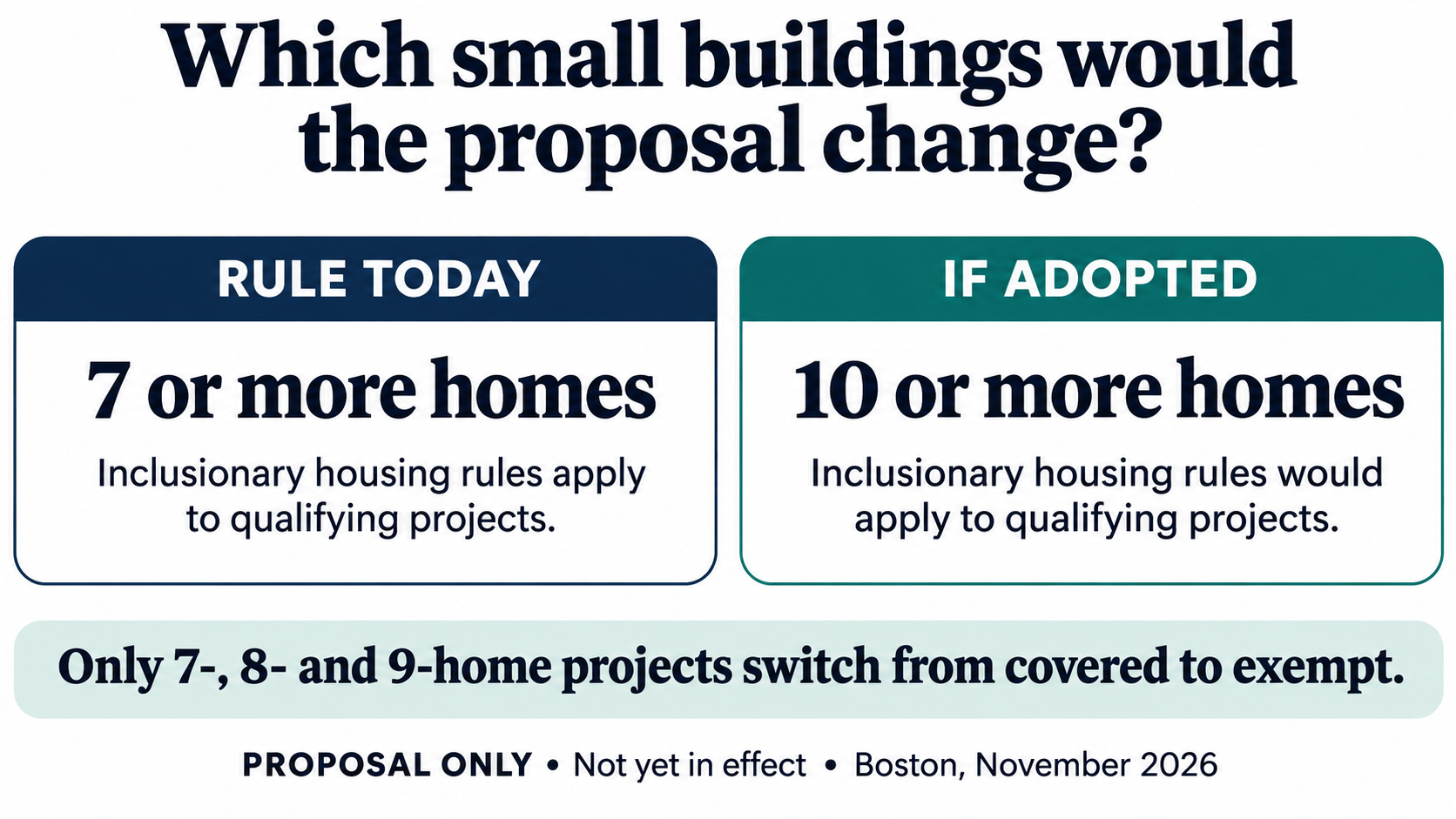
The city is considering removing that particular requirement for developments with seven, eight or nine apartments. The Boston Planning & Development Agency (BPDA) board voted on November 12 to advance the change, alongside several other adjustments. It has not become law, and it does not give anyone permission to build nine apartments wherever they want. Boston Planning Department, November 12 (opens in a new tab).
Why would Boston make it easier to build a small market-rate apartment building when so many people need affordable housing? The administration's argument is that some smaller projects cannot cover today's costs while meeting the requirement. But eliminating the obligation could also mean losing affordable apartments or funding from projects that would have happened anyway. Whether the change creates more housing than it gives up is the question Boston still needs to answer.
Only the seven-, eight- and nine-home range changes under this threshold proposal. Six-unit projects are already below the cutoff. Ten-unit and larger developments would still be covered when the other Article 79 conditions apply. The city says the higher cutoff would be a two-year trial, not a permanent change. The final start date and exact transition rules have not been confirmed. City proposal, November 9 (opens in a new tab); Boston's published rule comparison (opens in a new tab).
Importantly, "exempt from inclusionary zoning" does not mean "exempt from zoning." A project would still face the neighborhood's permitted uses, height and density rules, setbacks, applicable parking requirements, building and safety codes, and any needed zoning relief or design review. If other public funding, existing affordable-housing agreements or deed restrictions apply, those do not vanish because this one threshold changes. Boston's zoning viewer (opens in a new tab) is useful for checking a particular parcel.
Why does this matter financially?
Inclusionary zoning is how Boston asks certain private developments to help create homes with rents or sale prices restricted for income-qualified households. It is different from a normal apartment renting for whatever the market will bear.
For a covered small rental project, the current on-site requirement is generally 17% of the apartments or the comparable share of usable residential floor area, with affordability limits averaging 60% of area median income and no individual unit above 70% AMI under this small-rental standard. For a hypothetical nine-apartment building, 9 × 17% equals 1.53 affordable-unit equivalents. Nobody builds 0.53 of an apartment: the code provides rules for rounding, providing sufficient affordable floor area or making an eligible payment. It is inaccurate to say every nine-unit building simply owes one affordable apartment. Article 79, Sections 79-4 and 79-7 (opens in a new tab).
Here is a concrete illustration, not an actual project or universal developer fee:
| Hypothetical nine-unit rental in Zone C | Illustrative amount |
|---|---|
| Nine apartments, assumed at 800 usable sq. ft. each | 7,200 sq. ft. |
| 17% inclusionary floor-area equivalent | 1,224 sq. ft. |
| Published Zone C payment rate for rental contributions | $365 per required sq. ft. |
| Full cash-payment equivalent, only if the city approves that method | $446,760 |
Illustration assumes nine 800-square-foot apartments in Zone C. A full-payment route requires city approval; this is not an automatic charge or guaranteed saving.
This number is not an automatic bill or a guaranteed saving. Boston normally expects qualifying housing to provide income-restricted units. Full payment instead requires the Mayor's Office of Housing's approval; partial payments and compliance through unit sizes have separate rules. Actual project sizes, eligible area, neighborhood fee zone and approvals affect the result. The $365 rate comes from the city's 2024 Inclusionary Development Policy summary (opens in a new tab).
Why can the requirement matter so much? A market-rate apartment can earn more rent than an otherwise comparable income-restricted apartment, while both require land, a foundation, utilities, construction and financing. On a nine-unit building, there are relatively few market-rate apartments to absorb that difference. Removing the obligation might change whether the project gets a loan or whether a site can be purchased. It does not erase other project costs or prove that a building will be profitable.
Condominiums face their own small-project affordability and payment calculations. They should not be assumed to owe the rental payment shown above.
Did the seven-unit rule actually stop smaller buildings?
The city has a noteworthy figure. Boston housing chief Sheila Dillon told GBH (opens in a new tab) that in the four years before the inclusionary threshold dropped to seven units in October 2024, projects containing seven to nine homes averaged 144 permitted homes a year. Since then, the city had permitted eight homes in that size range, according to her account published November 10.
That is a striking slowdown. But 144 is an annual average and eight is a total over a different period, so they are not directly comparable annual rates. The figures are also city-reported, not an independently audited dataset. Construction prices, interest rates, lending conditions, and available sites have all changed. We cannot attribute the entire decline to the affordable-housing rule.
The administration estimates the temporary exemption could generate 100 or more additional homes per year, according to WBUR (opens in a new tab). This is the city's projection, not a verified forecast or a count of homes under construction. Permits alone would not prove it worked; Boston would need to track finished homes and what would have happened without the exemption.
What would Boston gain, and what could it lose?
Consider two possible outcomes for a hypothetical nine-apartment building:
If it would not have been built at all under today's rules, removing the inclusionary obligation could result in nine new apartments. That increases supply, although the homes would not necessarily be affordable to lower-income households. If existing homes were demolished, the net increase would be smaller.
If it would have been built anyway, Boston might still get the same nine apartments, but without the income-restricted homes or approved fund contribution that the developer would otherwise have provided.
That's the trade-off. Building more homes helps a market with limited supply, but a new market-rate apartment is not the same as an income-restricted apartment. The affordability requirement can both support below-market housing and make a small building's financing harder.
The debate crosses familiar lines. In the city's November 9 announcement, developer Evan Lank of Juice Capital describes seven- to nine-unit developments as difficult to finance under current conditions. Boston Tenant Coalition leader Kathy Brown emphasizes keeping the broader program's affordability percentages intact and says the targeted changes are preferable to reducing those percentages across all larger projects. Those are publicly attributed positions, not independent interviews or evidence that the proposed changes will succeed. City announcement (opens in a new tab).
What else is included in the package?
The threshold change is only one part of the residential proposal. Three other changes would affect projects still covered by inclusionary zoning:
- More time to pay: Allow approved affordable-housing fund contributions in seven installments instead of two, easing upfront cash demands without necessarily reducing the total amount owed.
- A different condo payment formula: Lower the full-unit condo payment percentage factor from 75% to 50% of the difference between market and restricted unit values. That is not a 25% cut to a building's total costs, and it does not describe rental-unit contributions.
- More flexibility on off-site housing: Move the existing half-mile rule for qualifying off-site affordable units from the zoning code to Mayor's Office of Housing policy. Off-site units would still require approval; the proposal does not guarantee that developers can move them anywhere they choose.
The separate proposal to keep commercial Linkage fees unchanged in 2027 concerns larger commercial developments and should not be confused with residential inclusionary zoning. Planning Department, November 12 (opens in a new tab).
Is it approved? What should residents watch?
The BPDA board has approved advancing a zoning petition, not putting the change into effect. The City Council can reject an inclusionary-zoning amendment by a two-thirds vote within 60 days after formal notification. If it does not reject the proposal, the Zoning Commission must still hold the required process and adopt the amendment before it can operate. We have not verified a final amendment or effective date as of November 16, 2026. Massachusetts Acts of 2020, Chapter 365 (opens in a new tab); BPDA update (opens in a new tab).
There are additional details residents and developers should not overlook. Today's Article 79 can apply to additions, conversions and related phases, not just brand-new standalone buildings; existing affordable-housing agreements and other requirements can also matter. The current code also already exempts certain developments exceeding its affordability requirements and dormitories. The board has proposed technical clarifications on project counting. The final proposed 2026 legal language was not publicly verified line by line for this article, so we cannot promise how a particular project already in review, addition or phased development will be treated. Article 79 applicability (opens in a new tab); November 12 board agenda, item 14 (opens in a new tab).
For renters: Nothing here creates an affordable apartment lottery today. Actual income-restricted listings and eligibility information appear through Boston Metrolist (opens in a new tab).
For neighbors: If you hear that a nine-unit project is coming to your block, check its specific zoning and permit filings. Ask whether the site already contains homes, whether other affordability commitments apply, and how many net new apartments it would deliver. The proposed exemption, by itself, does not approve the building.
For anyone trying to judge this policy: Track permits, construction starts, delivered apartments, net new homes, and affordable units or payments forgone. The most useful question is not just how many projects apply after the rule changes, but how many additional homes are actually delivered because of it.
The bigger takeaway: Boston may be able to make some small buildings viable by removing an obligation that is large relative to their size. But the city could also give up affordable-housing benefits without gaining new homes on projects that would have proceeded regardless. That is a real trade-off, and the evidence is not yet strong enough to declare either outcome the winner.