Your Boston Apartment Looks Renovated. Is It Actually Lead-Safe?
Where Boston has seen higher childhood lead exposure, how many older homes could be affected, and what renters can verify before signing.
In this article
A renovated kitchen in Dorchester can sparkle. So can a Brighton triple-decker or a freshly painted Somerville two-family. But at a showing, the most important lead-paint question is one you cannot answer by looking at the walls: has this particular apartment ever been inspected for lead hazards?
The concern reaches well beyond one neighborhood. Massachusetts says about two-thirds of its housing was built before 1978, when residential lead paint was banned. In Boston, the share in the state’s 2018-2022 survey data is 72%. That is not a count of contaminated homes; it is the share old enough that a renter or buyer should ask for documentation.
And there is a newer reason to ask. In April 2026, the Department of Public Health replaced its Tenant Lead Law Notification with a more detailed, ten-page form. A signed form is evidence that information was shared, not evidence that a unit was inspected or cleared. That distinction applies whether you rent from a national property manager or someone who owns one triple-decker.
Where in Greater Boston is the evidence of higher risk?
The latest statewide surveillance report names Boston, Everett, Chelsea, Malden and Lynn among 17 high-risk Massachusetts communities for 2024. It analyzes five years of confirmed childhood cases together with older housing and income. This is a classification for directing prevention resources. It does not label every street, landlord or apartment as hazardous.
| Community | Pre-1978 homes | Confirmed child cases, 2020-24 | Five-year rate / 1,000 screened |
|---|---|---|---|
| Boston | 72% | 181 | 2.6 |
| Everett | 78% | 28 | 3.6 |
| Lynn | 78% | 79 | 4.3 |
| Chelsea | 70% | 21 | 3.0 |
| Malden | 73% | 25 | 2.8 |
Source: Massachusetts DPH 2024 surveillance report, Appendix I. Ages 9-47 months, confirmed blood lead levels at least 10 micrograms per deciliter. Cases are newly identified across five years, not affected buildings or annual counts. Housing-age shares use ACS 2018-2022 estimates.
Inside Boston, an earlier city fair-housing assessment found higher elevated-blood-lead rates in certain census tracts in East Boston, Allston, Roxbury, Dorchester, Mattapan and Hyde Park. That finding is useful context, not a verified November 2026 ranking of whole neighborhoods. The underlying map data are older and conditions differ from block to block. A Beacon Hill or Cambridge apartment with aging windows may require the same questions.
One historical figure illustrates both the seriousness and the limits of neighborhood counts: a 2021 Boston Public Health Commission report said 62% of the city’s identified elevated childhood blood-lead cases in 2009-2013 were in Roxbury, Dorchester and East Boston. That is important historical evidence, but it should never be presented as today’s distribution or as proof that families in those neighborhoods caused the exposure.
How many homes could this affect?
The scale is large, even though the exact number of homes with active lead hazards is unknown. The 2024 DPH report estimates 66% of Massachusetts housing predates 1978. Its Boston community table gives 72%. For an order-of-magnitude sense only, applying that Boston share to the BPDA’s separate 2022 estimate of 307,836 total housing units works out to roughly 220,000 units old enough to merit a lead-history check. The estimates use different ACS survey windows and this is not an official count of lead-painted or unsafe units.
Why not simply count all of those as unsafe? A pre-1978 home may have no lead-based paint, may have been properly deleaded, or may contain intact paint without a legally identified hazard. Conversely, a recently remodeled kitchen does not tell you what happened to the original windows, doors, stair railings or exterior paint.
The other surprise: progress has stalled unevenly
Massachusetts recorded 458 children aged 9-47 months with confirmed lead poisoning in 2024, a rate of 2.7 per 1,000 screened. Its screening estimate was 74%, so these statistics do not mean every child was tested. The report also found that the 17 high-risk communities accounted for about 61% of identified cases in 2024, despite containing roughly one-third of the children in the state.
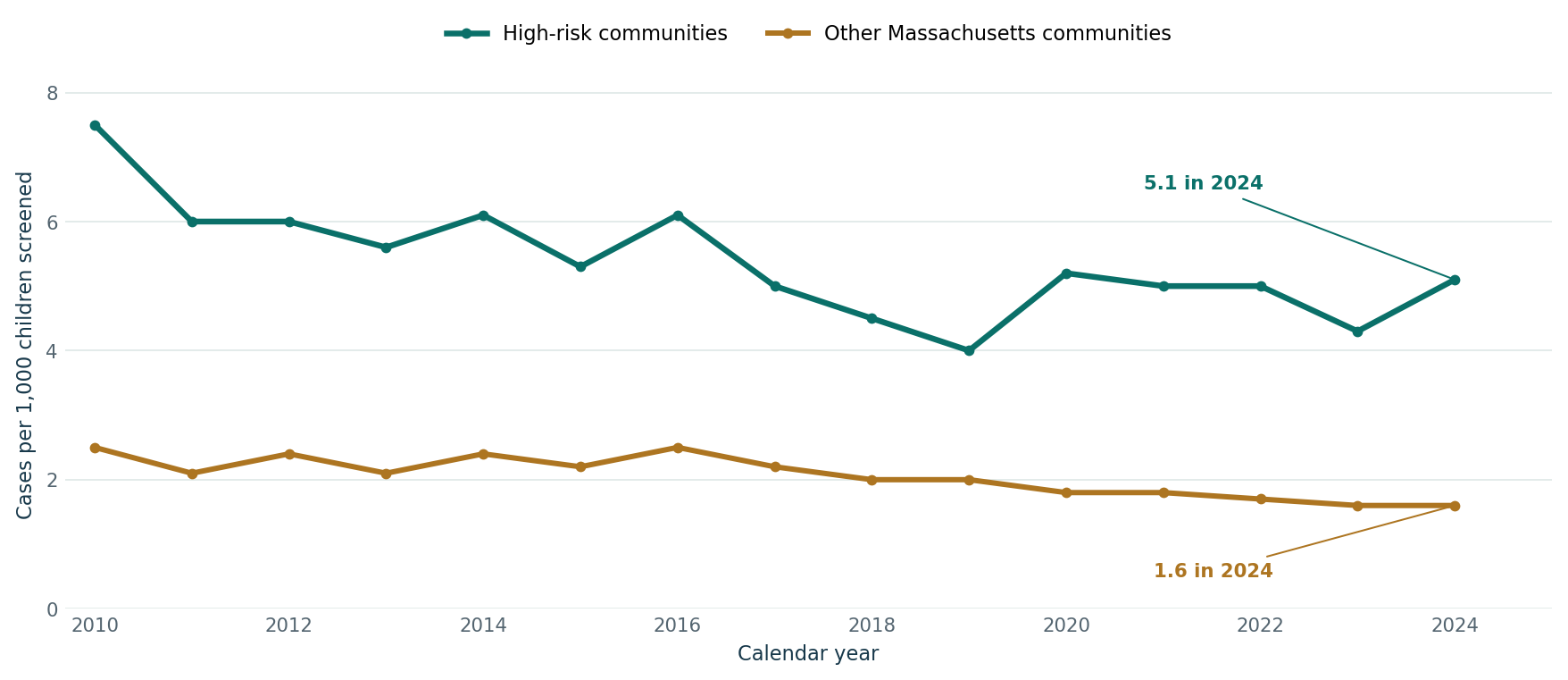
The longer record explains why that disparity is important. The chart below traces the state’s published lead-poisoning prevalence among screened young children from 2010 through 2024. High-risk communities improved over time, but their 2024 rate was 5.1 cases per 1,000, versus 1.6 elsewhere. The gap is more than threefold in that year. The lines compare groups as defined for each period; they do not show every child or predict any individual child’s exposure.
DPH also identifies lead paint as a sole or contributing source in 91% of childhood lead-poisoning cases. Another counterintuitive finding: for 2017-2023, lead-poisoning cases occurred in roughly equal numbers among children in owner-occupied properties and investor-owned rentals. That does not mean the two housing types have equal risk, because the number of children in each type differs. It means families should not assume ownership alone settles the question.
What Boston families and property owners have said
We did not find a recent, independently verifiable Boston renter interview about lead paint that could responsibly anchor this article as a new case. Instead, Boston Public Health Commission has documented firsthand stakeholder feedback. In a 2020 survey published in 2021, eight parents of children with lead poisoning asked for earlier education, help understanding tenant rights and assistance navigating inspection and deleading. Fourteen property owners described trouble finding contractors, managing paperwork and paying for temporary accommodations while work was done.
Those are dated survey responses, not interviews conducted by Boston Dwelling or a representative poll. But they explain a problem that remains practical for a renter today: even after someone learns an apartment might contain lead, understanding what to request and who must act can be confusing.
Has the city actually made homes safer?
Yes, there is measurable work, though the need remains difficult to quantify. Boston reported that more than 3,000 housing units have had lead hazards treated through Lead Safe Boston programs since 1994. The city’s latest program-year report describes a $4.46 million federal award for a four-year effort targeting 160 privately owned units, with 24 units completed during July 2024 through June 2025. A grant target is not the same as completed work, and the 24 units should not be mistaken for the citywide number of all homes made lead-safe that year.
The lease and four documents that actually matter
Before signing a lease for a covered pre-1978 rental, the owner must provide the Tenant Lead Law Notification and Certification Form, and give the most recent inspection or risk-assessment report and any compliance or interim-control letters if they exist. Massachusetts updated the form in April 2026. A standard large-building lease does not override the obligation.
| Document | What you learn | What you do not learn |
|---|---|---|
| Signed notification | Information received and acknowledged | That the unit passed inspection |
| Lead inspection report | Findings on that unit at that time | That all hazards were later fixed |
| Letter of Compliance | Formal lead-law compliance status | Permanent safety regardless of later repairs |
| Letter of Interim Control | Urgent hazards addressed temporarily | Permanent clearance; it generally lasts 1 year, renewable once |
Document descriptions based on Massachusetts DPH lead-law guidance; see sources.
A disclosure may legitimately say that no prior inspection record is known. That is not a clean bill of health. Check the specific unit, date and document with the state Lead Safe Homes records. An empty database result is not proof that the apartment is lead-free. If the property manager claims a recent renovation made the unit lead-safe, ask what licensed-inspector record supports that.
What is different for a household with a child under six?
Under the Massachusetts Lead Law, a pre-1978 dwelling where a child under six lives must be made lead-safe. The owner is responsible for complying, including inspection and correction of identified hazards. Housing providers cannot legally refuse a family with young children merely to avoid the cost of compliance. And renters without young children still have disclosure rights; it would be inaccurate to say every pre-1978 adult-only rental must already hold a compliance letter.
The five-minute check before you pay or sign
1. Ask when the building was built. A kitchen renovation date is not the construction date.
2. Ask for the updated state notification and any inspection, risk assessment, compliance or interim-control records. Request the documents for the exact apartment, not just the building.
3. Search Massachusetts Lead Safe Homes and save the results. Historical entries may lack attached reports; no result is not clearance.
4. Examine friction surfaces and past repairs without disturbing paint. Windows, doors, stairs, porches and dust created during renovation deserve questions for a licensed inspector; do not sand, scrape or use an unverified DIY test to declare a unit safe.
5. Know where to turn. For questions, call DPH’s Childhood Lead Poisoning Prevention Program at 800-532-9571. Boston renters can also contact BPHC about inspections and the City’s fair-housing office if they encounter discrimination.
A question worth sending before you sign
“Could you send the Massachusetts Tenant Lead Law Notification, any inspection or risk-assessment report for this unit and any Letter of Compliance or Interim Control? If there is no inspection report, could you confirm whether the unit has ever been inspected?” Save the written response alongside your lease.
What renters should take away
The useful lesson is not to avoid old Boston neighborhoods. It is to treat age, neighborhood patterns and attractive renovations as clues, never as a diagnosis. Thousands of homes have been treated, and new disclosure forms make it easier to ask better questions. The document that helps most is the one proving what a licensed inspector found and what was actually corrected in your unit.