You can afford Boston rent. Can you afford to buy?
The down payment is only the first hurdle. A closer look at equity, condo costs and what Massachusetts residents say housing is doing to their plans.
By Boston Dwelling · Published · 6 min read
Your lease renewal arrives. The monthly number already feels too high, and another year of paying a landlord is hard to swallow. You open a few condo listings and wonder whether that money could finally be building something of your own.
Then you run the numbers. The down payment is difficult enough. The more unsettling surprise is what ownership could take out of your paycheck every month after you have saved it.
That is the Boston rent-versus-buy problem worth examining: can you afford the home and still afford the rest of your life?
If buying feels delayed, you have company
A 2026 MassINC Polling Group survey of 854 Massachusetts residents found that 21% said their financial situation had prevented them from buying a home, while another 20% said it had delayed them. Together, that is 41% of all respondents, not just renters. [1] (opens in a new tab)
Among respondents who rented or had another living arrangement, only 27% planned to buy in Massachusetts within five years. Another 13% planned to buy elsewhere; 38% did not plan to buy and 22% were unsure. Those are plans, not predictions of who will actually become an owner. [1] (opens in a new tab)
The distinction matters. A household can want the stability of ownership while deciding that another year of renting is the more workable choice.
Boston has an unusually wide gap, but averages are only the opening clue
Zillow’s September 2026 report put typical asking rent in its Boston metro at $2,987 a month and its modeled new-owner payment at $5,926, assuming 10% down and a 30-year fixed mortgage. That is a $2,939 monthly gap, about 98% above rent. Nationally, the corresponding figures were $1,932 and $3,037, a gap of about 57%. [2] (opens in a new tab)
These are metro-wide measures of different housing pools, not the same home offered for rent and for sale. They tell you why the decision deserves a closer look. They cannot tell you whether your particular condo is a better deal than your apartment. Zillow’s homeowner methodology includes taxes, insurance and maintenance but excludes HOA dues. [3] (opens in a new tab)
Here is what a $650,000 condo payment actually buys
Consider a household paying $3,600 in rent, plus $20 for renters insurance, and weighing a $650,000 condo. This is an illustrative budget, not a pair of matched listings or a claim about average two-bedroom costs. The point is to see the moving parts.
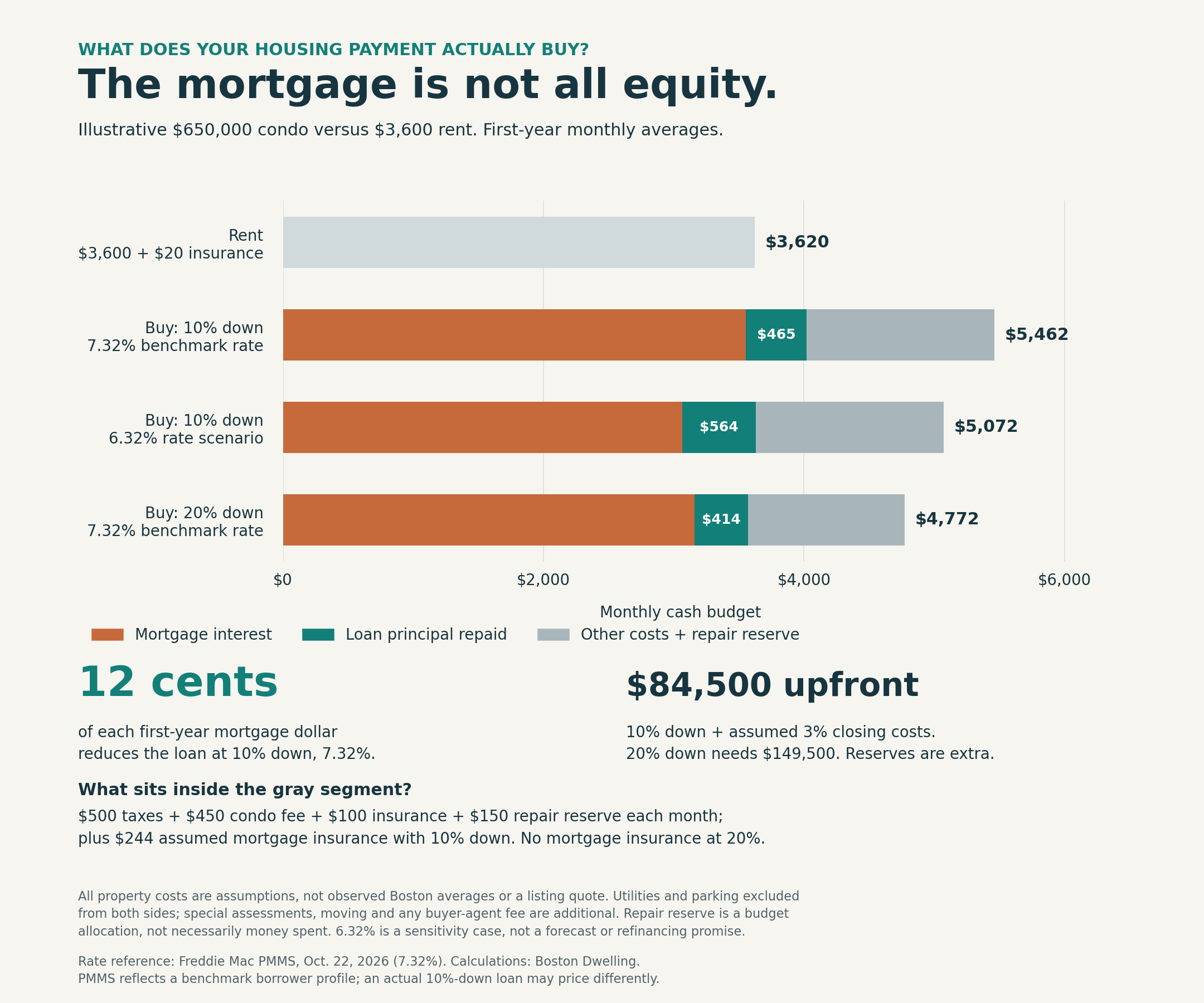
At 10% down and a 7.32% mortgage rate, the principal-and-interest payment is about $4,019. Add the chart’s assumed taxes, condo fee, insurance, mortgage insurance and repair reserve, and the monthly budget reaches about $5,462. That is $1,842 more than the rental budget. [4, 5] (opens in a new tab)
The surprising part: most early mortgage dollars do not build equity
In the first year of that loan, about $42,637 goes to interest and $5,585 reduces the balance. Just 11.6% of the principal-and-interest payments build equity through debt repayment, or roughly 12 cents per mortgage dollar. On a monthly average, that is about $465 of principal. [5] (opens in a new tab)
Principal repayment is valuable. It is money moving into your ownership stake, although it is not readily available cash. But it is a much smaller part of the early payment than someone hearing that a mortgage pays yourself might imagine.
The renter in this illustration has about $22,108 less cash committed to housing over the first year, if the budgets hold. The buyer repays about $5,585 of principal. Neither number settles which household ends up wealthier: home appreciation or depreciation, investment returns, taxes, closing costs and eventual selling costs also matter. The renter only accumulates the difference if they actually save it. [5] (opens in a new tab)
For the buyer, the share going to principal grows over time. That is one reason a long stay can improve the case for ownership. Buying can also deliver benefits a spreadsheet cannot price neatly: control over the home, more certainty about staying and the ability to make it your own.
A lower rate helps. A larger down payment has its own price
The chart holds the home price and property-cost assumptions steady so you can test two common hopes. At 6.32%, one percentage point below the benchmark, the 10%-down monthly budget falls by about $390 to $5,072. It still exceeds the rental budget by about $1,452. That is a sensitivity calculation, not a forecast or an assumption that refinancing will be available. [5] (opens in a new tab)
Putting 20% down at 7.32% reduces the monthly budget to about $4,772, helped by the smaller loan and removal of assumed mortgage insurance. But the down payment rises by $65,000. With the same assumed closing costs, cash needed upfront rises from $84,500 to $149,500, before moving expenses and emergency reserves. That additional cash becomes equity rather than a fee, but it is no longer available for everyday needs. [5] (opens in a new tab)
A condo fee also needs a closer read. Check whether it pays for heat, water, insurance or work you would otherwise fund separately. Use an allowance for repairs inside your unit without counting association-covered expenses twice. Then review reserves, upcoming projects and possible special assessments. A low fee is not enough evidence that the building is inexpensive to own.
Renting longer does not necessarily mean wanting ownership less
An August 2026 New York Fed analysis found that about 65% of renters would prefer to own if they had the financial resources. Yet renters’ average reported chance of moving within three years fell from roughly 57% in 2014 to 37% in 2026. Those are average subjective probabilities, not the share who will definitely move. [6] (opens in a new tab)
The researchers connected declining mobility with affordability concerns and weaker expectations of future ownership. Their analysis identifies associations rather than proving one cause. Still, it challenges an easy explanation: renters staying put are not necessarily choosing a carefree, flexible lifestyle. Some may feel that the next step has become harder to reach. [6] (opens in a new tab)
Make the decision about your next few years
Picture the life you expect to have in the home. Would you stay if your job changed? Is the commute workable five days a week? Would the layout still fit if your household grew? Would you feel comfortable paying for a repair shortly after closing?
A June Zillow model put Boston’s rent-versus-buy break-even horizon at 13.9 years, versus six nationally. It uses a separate single-family comparison and assumptions about prices, rent growth, investing and transaction costs. It is useful context, not a personal deadline and not a result calculated from our condo illustration. [7] (opens in a new tab)
Start your own comparison with homes you would actually choose in the same area, with similar space, condition and commute. Use the real tax bill, insurance quote and condo documents. Check any owner-occupant exemption with the municipality. Add parking and utilities to both budgets based on what each home includes.
Then give the monthly gap a purpose. Would renting let you build a reserve or keep saving toward ownership? Would buying give you enough stability and control to justify a higher monthly bill? If you would rent for years but spend every dollar of the difference, a comparison that assumes disciplined investing will not describe your life.
You do not need to prove that renting or buying wins everywhere. You need a home that works for you, a realistic time horizon and enough room in the budget to enjoy living there.
Have you compared a Greater Boston rental with a home you could realistically buy? What surprised you most: the down payment, the condo fee or the monthly total? Tell us at hello@bostondwelling.com.