What do birth and marriage rates have to do with Boston’s Green Line?
A new federal funding proposal offers a practical lesson for choosing a home: distinguish the transit service you can use today from improvements still being planned.
By Boston Dwelling · Published · 4 min read
About one in ten Greater Boston workers usually got to work by public transportation in 2024. The Census estimate was 9.8% of workers age 16 and older in the Boston-Cambridge-Newton, MA-NH metro area. That gives a housing decision a practical test: can you make the commute you need now?
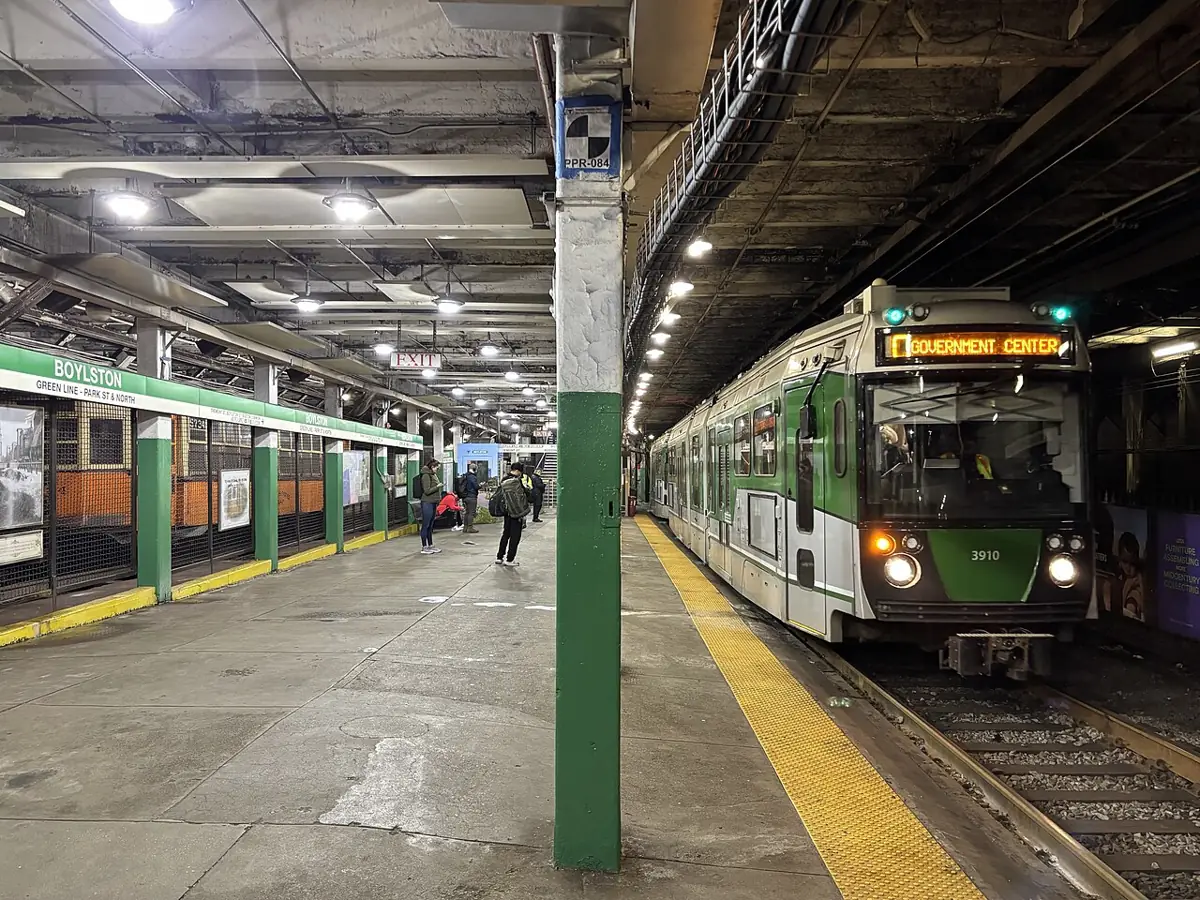
A Green Line train arriving at Boylston station, photographed February 28, 2025. Photo: IliketrainsR211T · Source: Wikimedia Commons · CC BY 4.0 · Resized for web; preview thumbnails may be cropped
An apartment listing says “steps from the Green Line.” A neighborhood pitch points to bigger trains and future upgrades. Those claims answer different questions: what can you use when you move in, and what might improve later?
On October 1, 2026, the Federal Transit Administration proposed changes to its Capital Investment Grants program, including a funding bonus tied to birth and marriage measures along transit corridors. As checked October 8, the guidance is not effective. Comments are due November 16.
The housing question comes first
Our practical advice: evaluate a home using today’s commute, then assess planned improvements separately. Would the location still work if an upgrade took longer? Renters can compare its timeline with their lease. Buyers can consider their likely time in the home without treating an announced project as a guaranteed benefit.
Try the door-to-door trip at the time you expect to travel. Include walks, transfers and a backup when service is disrupted. A station on a map does not describe the whole journey. Save current service information alongside the project announcement so you know which part of your decision depends on future delivery.
What Washington is proposing
Capital Investment Grants support major transit infrastructure. The proposed formula for qualifying New Starts and Core Capacity projects would begin at a 40% CIG share of project cost, then adjust it for project ratings. This proposed starting point is not a statement that every project currently receives 40%.
Demographic bonuses could add up to five percentage points for birth rates and another five for marriage measures. The study area would extend one mile around the project corridor. The proposed “marriage rate” means the share of people age 15 and older who are married, not the number of weddings that year.
FTA says its revisions aim to streamline the process and improve accountability. Those are stated goals, not demonstrated outcomes. Readers can consider how demographic measures should sit alongside transportation needs and project performance. We have not calculated the Green Line corridor’s demographic eligibility.
What 10 percentage points means
Hypothetical project, not a Boston grant forecast · Observed Illustration of the October 1, 2026 proposal · Illustration / estimate · Values in million dollars
40% federal share
50% with maximum bonus
Show the exact values
| Category | Value |
|---|---|
| 40% federal share | 400 million dollars |
| 50% with maximum bonus | 500 million dollars |
Author calculation for a hypothetical $1 billion project: × 40% = $400 million; × 50% = $500 million. Difference: $100 million. Other rating adjustments held constant, with sufficient requested funding and applicable limits. Alternative scenarios, not actual awards or a forecast.
Source: Federal Transit Administration / Federal Register, Notice of proposed CIG policy guidance, funding formula and Engineering treatment (October 1, 2026, sections II.C.6 and Tables 1 and 2)
A request is not an awarded grant
FTA’s dashboard, updated September 10, 2026, listed the Green Line Transformation Core Capacity Program at $4,075.3 million in project cost and $2,037.7 million in requested CIG funding, approximately 50%. It listed the program in Project Development. That is a dated planning snapshot, not confirmation of its stage today or an awarded $2.04 billion grant.
Boston Region Metropolitan Planning Organization October 1 meeting materials also describe proposed Core Capacity funding as a preliminary estimate for a future grant application. They identify other funding committed to component projects. Seeking additional money does not mean a program has no funded work.
The proposal would preserve approved CIG funding amounts for New Starts and Core Capacity projects already in Engineering. Stage matters. These documents do not establish that Boston has lost funding because of the proposal or that rents and home prices will change.
Read the milestone before relying on the promise
Step 1: Plan or funding request
A sponsor describes improvements and seeks money.
Step 2: Approved commitment
Check the specific funding decision and its conditions.
Step 3: Construction and testing
Track work and remaining delivery requirements.
Step 4: Service available
Verify what riders can actually use.
Source: Federal Transit Administration, Full proposed CIG policy guidance, process and demographic definitions (October 1, 2026; printed pages 9 to 24, especially 16 and 17)
What better local communication could look like
Our editorial view: updates should put current service, committed money, requested money and remaining milestones together. That would help readers evaluate improvements without dismissing their potential value or treating delivery as certain.
Three things to do before choosing a home
- Try today’s door-to-door commute and identify a workable backup.
- Check the date, funding status and remaining milestones behind promised upgrades.
- Ask whether the home still suits your needs if improvements arrive later.
Want to weigh in?
Read the proposal and form your own view. FTA accepts public comments through November 16, 2026, under docket FTA-2026-0331. You can explain which funding criteria you support or would change and why. Comments are public, including personal information you choose to include.
Read the proposal and official comment instructions (opens in a new tab)
Submit a public comment on Regulations.gov (opens in a new tab)