Bunker Hill is changing. What could living there look like?
A closer look at the new homes, future streets and residents behind Charlestown’s biggest housing rebuild.
By Boston Dwelling · Published · 4 min read
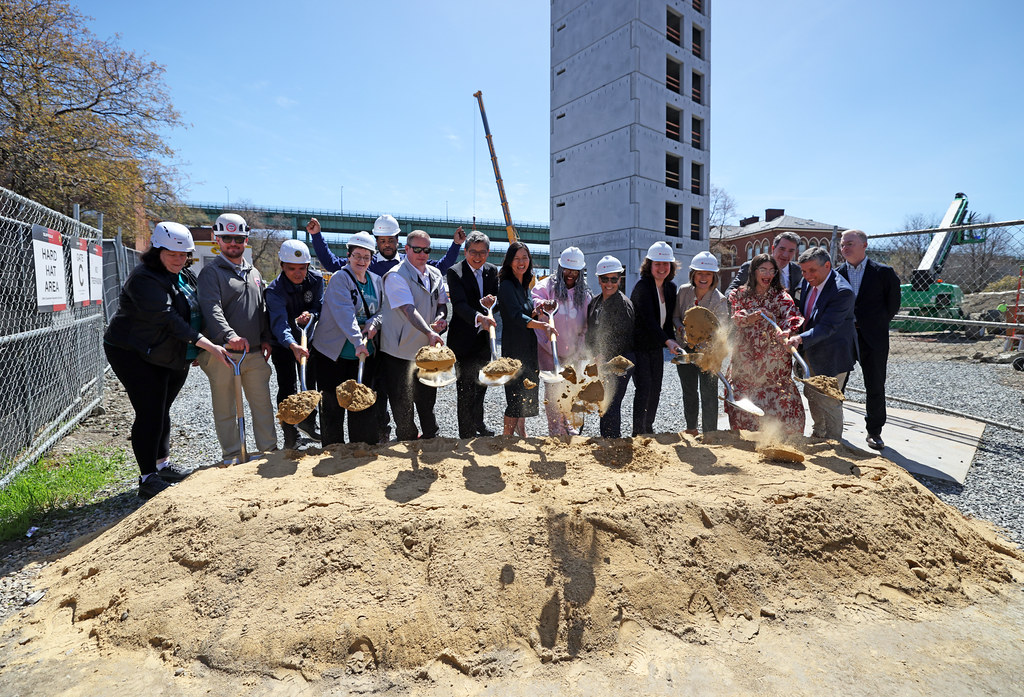
Building F’s groundbreaking, Charlestown, April 28, 2026. Photo: John Wilcox · Source: City of Boston Mayor’s Office · Noncommercial use with attribution; City of Boston Mayor’s Office terms · Resized for display; no crop or other edits. Homepage previews may crop to fit.; preview thumbnails may be cropped
If you moved into one of Bunker Hill’s new apartments, what would be outside your front door? A park? A construction fence? A bus stop that fits your commute? For now, the answer depends on the building and the phase.
Charlestown’s redevelopment already has a completed apartment building and another under construction. The longer-term vision is much bigger: a rebuilt public housing community with additional market-rate homes, new public spaces and streets that connect with the neighborhood around it.
Where the changes are happening
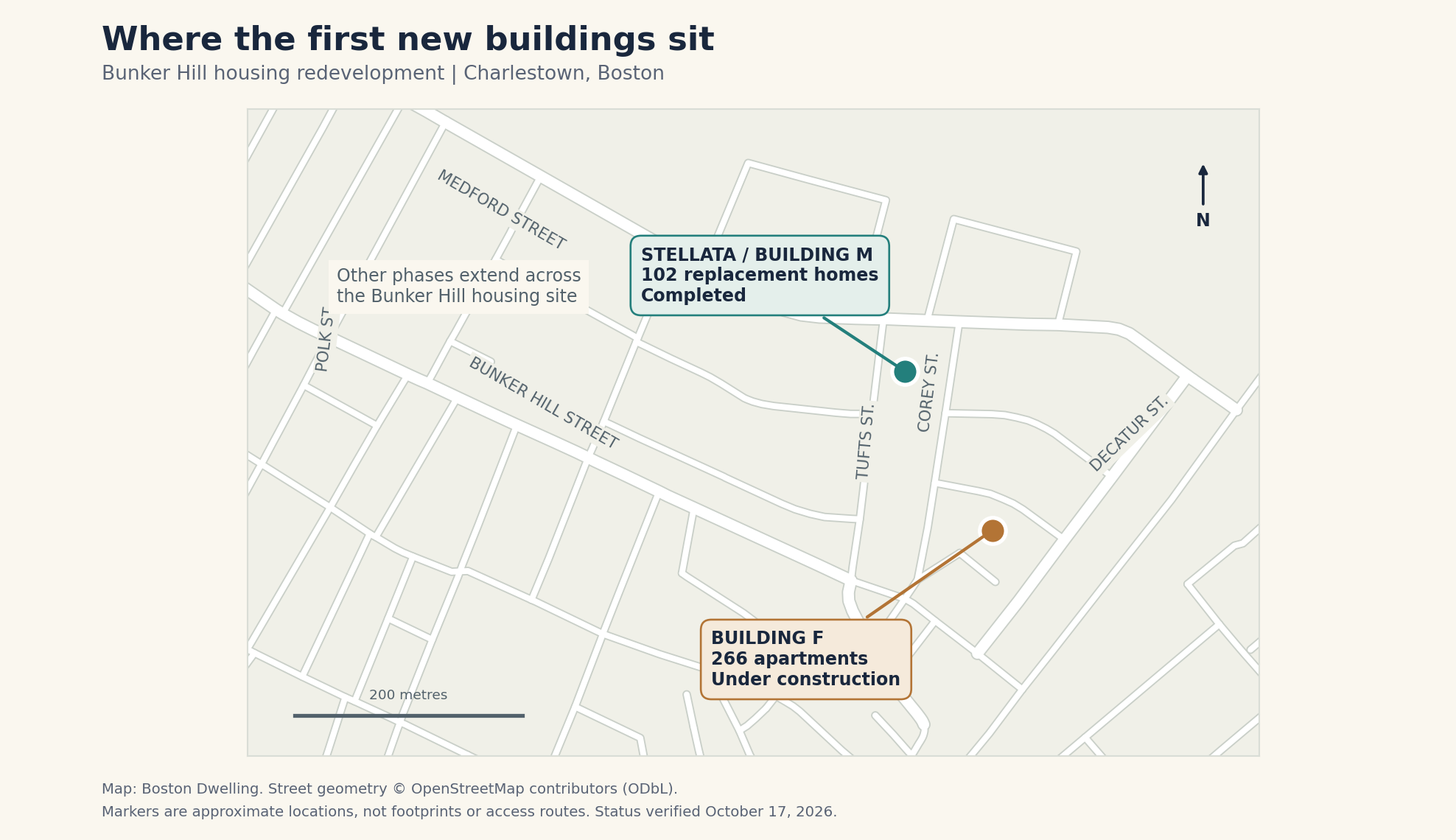
The first two buildings sit near Corey Street on the eastern side of the housing site. Stellata, also called Building M, is at 40 Corey Street. Building F is nearby, between Samuel Morse Way and Moulton Street. The full redevelopment stretches farther west across the existing Bunker Hill housing community.
According to BHA’s April 2026 update (opens in a new tab), Stellata delivered 102 replacement apartments in January 2025 and was fully occupied. Building F broke ground on April 28, 2026; a September City update (opens in a new tab) confirmed construction underway. Its 266 apartments are planned as 208 market-rate rentals and 58 deeply affordable replacement homes.
What could a rebuilt Bunker Hill feel like?
The approved on-site master plan (opens in a new tab) calls for 2,699 homes across 15 buildings. But the more useful way to picture it is from the sidewalk: homes connected by neighborhood streets, places to sit outside, space for children to play and storefronts along Bunker Hill Street.
The development team’s published full-site illustration (opens in a new tab) shows that ambition. It is a watercolor rendering, not a photograph or a promise that every later building will look exactly that way. The team explicitly says future phases will go through public design review.
What residents have been saying
For existing residents, the redevelopment begins with the condition of the homes they already occupy. In January 2025 reporting by the Charlestown Patriot-Bridge (opens in a new tab), Michael Coughlin Jr. described resident testimony at a City Council hearing on the Housing Accelerator Fund.
“We really need this, and I want to live a little bit better than I live right now.”
Nancy Martinez, then president of the Charlestown Resident Alliance, as reported by the Patriot-Bridge, January 23, 2025.
Nancy Martinez, then president of the Charlestown Resident Alliance, as reported by the Patriot-Bridge, January 23, 2025. This was public testimony, not an interview conducted by Boston Dwelling.
The same report described resident-board member Phil Wright’s account of repeated flooding and a cockroach problem in his apartment. Those were his reported experiences at that time, not a condition assessment of every Bunker Hill home today.
More recent neighborhood interviews point to another priority: how new development connects to the rest of Charlestown. In The Scope’s May 15, 2026 reporting (opens in a new tab), Gregory Zapata interviewed Charlestown residents Kayli Walker and Mike Chulumecky about the area around Hood Park and Rutherford Avenue. Walker described it as isolated but improving; the pair hoped future buildings would fit the neighborhood’s appearance.
That interview concerned a different part of Charlestown, not the Bunker Hill housing site. It is useful context for the question this rebuild also raises: can adding homes make the neighborhood feel more connected?
New homes, with a long transition in between
The on-site plan combines 1,010 deeply affordable replacement homes with 1,689 market-rate apartments, with 100 additional replacement homes planned elsewhere in Charlestown. The replacement homes serve an existing public housing commitment. They are not interchangeable with apartments advertised to the general rental market.
BHA says relocated families have a right to return to a new affordable home on site (opens in a new tab). Keeping that commitment while construction moves through the neighborhood is central to whether the transformation works for the people already living there.
For future renters, more apartments could mean more choices, but no verified Building F leasing launch or opening date is established here. Nearby residents also face a transition: the project website (opens in a new tab) lists excavation, foundations and building erection among ongoing work.
What to check before picturing your move
Current transit is part of that decision. Route 93 (opens in a new tab) connects Sullivan Square and Downtown via Bunker Hill Street, with the Orange Line at Sullivan. Try the actual journey at your travel time, including the walk, wait and transfer.
The promise of Bunker Hill is more than a larger apartment count. It is whether residents get better homes and an easier neighborhood to live in. The completed building is a start. The rest needs to be judged as it arrives.
Three things to carry into a housing search
Match your moving date to a real building. A master-plan approval is not a leasing announcement. Get actual prices, availability and written move-in terms.
Look beyond the front door. Check the bus trip, construction beside the building and which parks, sidewalks and shops are actually open.
Keep existing residents in the picture. Replacement homes and return arrangements are core commitments, not incidental benefits of the new market-rate apartments.
Have a question about Bunker Hill or housing in Greater Boston? Email Here. We’ll follow up with an answer directly or explore your question in a future article.