Could an empty office building become your next Boston apartment?
Boston is turning offices into homes. Here's what has been completed, what is still coming, and what renters should know before choosing a converted building.
By Boston Dwelling · Published · Updated · 4 min read
If you're looking for a Boston apartment, a vacant office can look like a missed opportunity. Turning those floors into homes takes more than adding a few walls: bedrooms need usable layouts, and kitchens and bathrooms need building systems that were designed for something else.
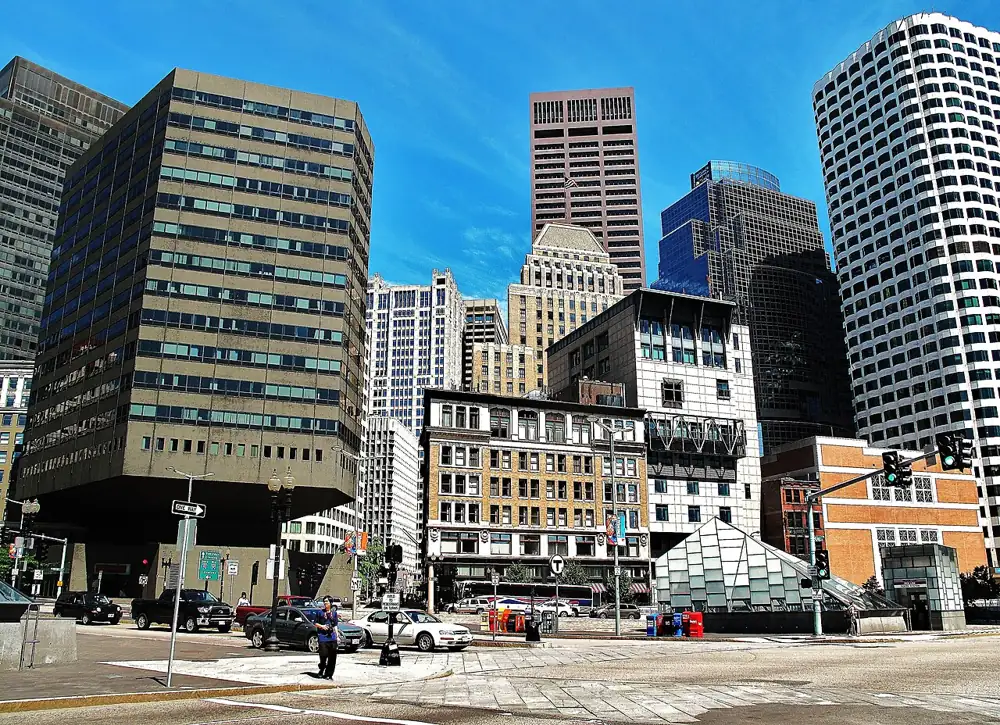
Boston's Financial District, photographed July 31, 2011. Neighborhood context, not a photograph of a verified conversion project. Photo: Francisco Anzola · Source: Wikimedia Commons · CC BY 2.0 · Resized for web; preview thumbnails may be cropped
Boston is trying to make that switch. For renters, the draw is a home in an established neighborhood, sometimes above existing shops and close to public transportation. The question is how soon those homes could become an option for your next move.
The city's September 2026 presentation counted 2,420 homes across 28 conversion applications, spanning several neighborhoods. Its project table identified just one completed project and seven under construction. Much of the housing remained further back in the process.
How much housing has reached construction?
Boston office-conversion homes by project stage
City of Boston · Observed September 2026 city program snapshot; verified October 12, 2026 · Values in homes
Completed
Under construction
Earlier stages
Show the exact values
| Category | Value |
|---|---|
| Completed | 15 homes |
| Under construction | 416 homes |
| Earlier stages | 1,989 homes |
Planned homes are counted within each project's reported stage; these are not available listings. Earlier stages include applications and approvals. Source: Boston Planning Department, September 2026 presentation, pages 10-11. Author's sums: 24 + 25 + 92 + 77 + 18 + 110 + 70 = 416 construction homes; 2,420 - 416 - 15 = 1,989 earlier-stage homes.
Source: Boston Planning Department, September 2026 Office-to-Residential Conversion Program presentation (September 2026; verified October 12, 2026)
If your lease ends next year, focus on the buildings that can actually offer a move-in date. Applications and approvals still have steps to clear before anyone can unpack.
What's open, what's being built and what's still proposed
| Project and neighborhood | Total homes | Income-restricted homes | Last verified milestone |
|---|---|---|---|
| 281 Franklin Street, Downtown | 15 | 3 | Completed in September's city table; the city reported full occupancy in December 2025 |
| 31 Milk Street, Downtown | 110 | 22 | Approved in May 2025; under construction in September's table |
| 140 Providence Street, also called 31 St James Avenue, Back Bay | Approximately 476 proposed | 95 listed in September's program table | Proposed; public meeting scheduled for October 14, 2026 |
Counts follow the city's September program table. Proposed counts can change. Completed buildings do not necessarily have vacancies, and construction does not establish a move-in date. Sources: September 2026 program presentation, December 2025 occupancy announcement, May 2025 approval announcement and October 2026 meeting notice; linked in the sources footer.
Why can't every empty office become housing?
The building's shape matters. An office floor can stretch deep into a building, while apartment layouts must fit around windows, corridors, columns and the existing elevator core. A generous amount of office space does not automatically translate into comfortable bedrooms.
Then come the building systems. Apartments distribute kitchens and bathrooms throughout floors that may have concentrated office restrooms. Mechanical, electrical and plumbing systems can require substantial changes. Architects must also resolve access, circulation and applicable safety requirements.
Gensler's conversion work points to floor layout, natural light, building form and servicing as key feasibility checks. Each building needs its own assessment.
Financing creates another hurdle. Reusing a structure still requires acquisition costs, construction funding and enough expected income to support the finished building.
What Boston offers, and what residents get
Boston's program combines faster review with negotiated property-tax relief. The current program page describes an average abatement of up to 75% for up to 29 years. Applications remain open through December 31, 2026, according to the city's extension announcement.
The program also carries housing requirements. Its current rules specify 17% of newly created units for households earning up to 60% of area median income, with an additional 3% reserved for voucher holders in large projects. Individual buildings' agreements and application rules determine access.
The tradeoff for residents is the tax relief Boston gives up to encourage housing. In our view, the test is what it delivers: completed homes, affordability commitments that can be enforced and a clear accounting of the financial concessions.
What living there could mean
Downtown already has subway infrastructure, including Red and Orange Line service at Downtown Crossing. That is existing access, not a promised future improvement. Test the actual walk and commute, including accessibility and service alerts, before choosing an address.
Conversions could also put more residents near shops after office hours, a stated city goal. Whether a particular building suits you still depends on daylight, noise, storage, groceries, rent and the apartment itself.
A proposal you can review this week
The 140 Providence Street proposal would combine approximately 476 homes with retail and restaurant space. It proposes no on-site parking. Those details make transit access, deliveries and neighborhood impacts useful questions for residents.
The city's virtual public meeting is Wednesday, October 14, from 6-8 p.m. The project page accepts comments through October 26. Readers can review the plans and reach their own conclusions.
October 14 public meeting: details and registration (opens in a new tab)
Review 140 Providence Street and submit comments through October 26 (opens in a new tab)
Before you put a conversion on your apartment shortlist
- For an upcoming move, confirm leasing availability and occupancy readiness.
- For income-restricted homes, check household eligibility and the individual application process.
- When touring a conversion, inspect the layout and everyday conveniences as carefully as its location.