Can tax breaks get Boston’s stalled apartments built?
Four developments could add about 1,400 homes. The next question is what residents get for the relief, and when.
By Boston Dwelling · Published · 5 min read
You can walk past a future apartment site for years without seeing a single apartment become available. For someone deciding whether to renew a lease in Allston or keep looking near Sullivan Square, an approved building is still just a possibility until someone can pay to build it.
Boston is trying to close that gap with temporary property-tax relief. On October 15, the Boston Planning & Development Agency Board advanced arrangements for four previously approved developments. The Planning Department says the action allows formal negotiations to begin (opens in a new tab). The agreements, financing and construction still matter; the announcement does not give apartment hunters a move-in date.
The question for residents is straightforward: if developers receive a financial break, what should Boston expect in return? The answer involves more homes, some income-restricted apartments, and a public cost that deserves a closer look than the word “temporary.”
Four projects, with a financial hurdle still to clear
The City’s September tax-relief announcement (opens in a new tab) describes about 1,400 planned homes across these sites. Its figures provide a consistent snapshot of the package:
| Project / neighborhood | Homes | Income-restricted homes |
|---|---|---|
| One Mystic Avenue / Charlestown | 408 | 45 |
| 22–24 Pratt Street / Allston | 318 | 27 |
| 83 Leo M. Birmingham Parkway / Brighton | 333 | 52 |
| Allston Yards Building D / Allston | 341 | 61 |
| Announced total | 1,400 | 185 |
Source: City announcement, September 14–15, 2026. These are announced package counts, not available apartments or reconciled final permit counts. October 15 Board authorization opened tax-agreement negotiations for all four.
There is a wrinkle in the public record: some project pages and later reporting carry different counts for One Mystic and Pratt Street. This table preserves the City announcement’s figures rather than mixing versions. A final agreement and permit set should settle what each project actually delivers.
Allston Yards also shows why the stage of a development matters. The developer’s 2021 construction announcement (opens in a new tab) concerned Building A, including housing and a grocery store. Building D is a separate phase. Earlier construction at the same development does not establish that this next building is underway.
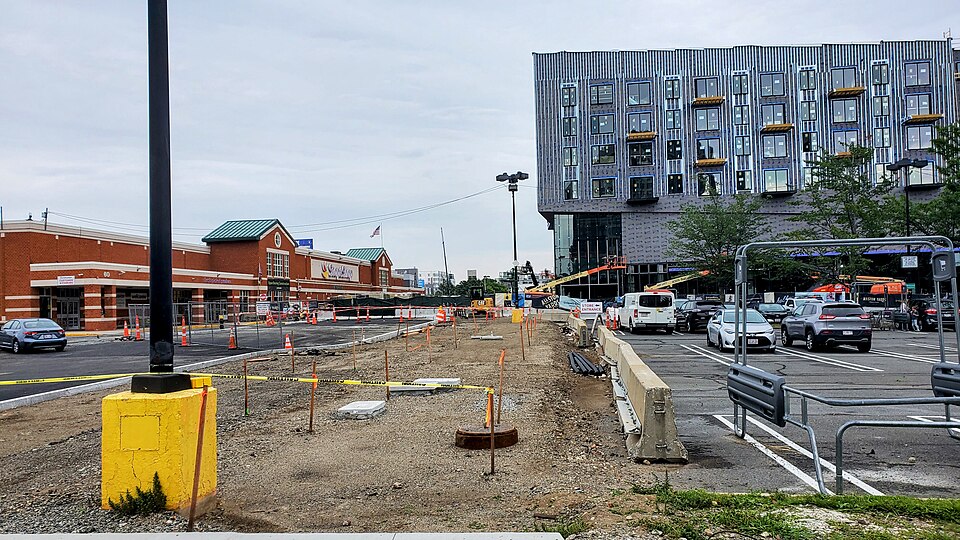
Earlier-phase construction at the Allston Yards / Stop & Shop site, August 7, 2023. This does not depict Building D under construction or the site’s current appearance. Photo: Ethan Long / Flickr, via Wikimedia Commons · Source: Wikimedia Commons · CC BY-SA 2.0 · Resized proportionally; no crop or scene edits.; preview thumbnails may be cropped
What the tax break would change
Under the City’s proposal (opens in a new tab), developers would keep paying at least their current property taxes while receiving temporary relief from part of the increase associated with development. The initial estimate was $31.5 million across the four projects, contingent on construction beginning within agreed deadlines. That is an estimate of relief over time, not a check handed over on approval day.
The October 15 agenda (opens in a new tab) uses a payment-in-lieu-of-taxes agreement, often shortened to PILOT, and demonstration-project powers. In plain English, officials are authorizing a negotiated tax arrangement. The agenda is evidence of the authority sought; the City’s subsequent update confirms the Board action. Neither substitutes for reading the executed contracts.
A project has to cover its expenses and support the financing needed to build it. Reducing a future expense can improve that calculation. But the amount of help matters, and a tax agreement alone cannot guarantee a lender or investor will commit.
The City says its approach avoids a net revenue loss. To assess that claim, ask what it is being compared with. Keeping the same tax receipts as an undeveloped site is different from collecting everything a completed building would ordinarily owe. Here is a deliberately simplified example for one illustrative year:
More revenue and a tax break can happen together
Illustrative Boston development; no actual property · Observed One hypothetical year, not a forecast · Values in US dollars
Site stays as it is
Completed, temporary relief
Completed, ordinary taxes
Show the exact values
| Category | Value |
|---|---|
| Site stays as it is | $100,000 |
| Completed, temporary relief | $300,000 |
| Completed, ordinary taxes | $500,000 |
Assumed amounts only. Compared with the unchanged site: +$200,000. Compared with ordinary completed-building taxes: −$200,000. Not the terms of any of the four projects.
Source: City of Boston / Mayor’s Office, City tax-relief announcement
In that example, the City collects $200,000 more than from the unchanged site, while granting $200,000 in relief compared with ordinary completed-building taxes. Both statements can be true. These invented round numbers explain the comparison; they are not the terms of any Boston project.
The hardest question: would these homes happen anyway?
A 2024 study published by the Federal Reserve Bank of Boston (opens in a new tab) identifies the central difficulty: subsidies can reach buildings that would have been built without them. The useful measure is the cost of the additional homes the policy actually causes, not simply the number of homes receiving help.
That study assessed other abatement scenarios using an earlier development pipeline. It does not evaluate these four 2026 deals, and its modeled costs should not be treated as their price tag. Its lesson still gives residents a good test: what evidence shows that the relief changes the construction decision?
Boston’s initial estimate divided by its announced 1,400 homes is $22,500 per planned home. That arithmetic does not establish the cost per additional home caused by the policy. It also does not establish how many apartments a typical renter could afford. Those are separate questions, and both deserve answers.
For a renter, the immediate benefit would be another potential place to live once construction and leasing actually happen. There is no promise here of a particular market rent, a lottery opening date or a reduction in the rent on your current apartment.
The affordability benefit also has two forms. The City’s package includes on-site restricted homes and contributions toward housing elsewhere. Its planning glossary (opens in a new tab) explains that the older Inclusionary Development Policy allowed on-site homes, off-site homes or cash contributions. The September 28 meeting notice (opens in a new tab) specifically flagged a proposed partial buyout at Pratt Street. Money for another housing project is valuable, but it is not an apartment available at this address today.
The public should be able to follow both results: when these buildings open, and when any separately funded affordable homes are delivered. That is a more useful scorecard than treating either a Board approval or a developer contribution as the finished product.
What to watch next
Look for the signed deal. The relief amount, payment schedule, construction deadline and consequences for missing it should be clear before judging the bargain.
Follow the homes as well as the money. Track the final unit mix, income rules, on-site apartments and delivery of housing funded elsewhere.
Keep your moving plans grounded. A financing incentive can help a future building. For your next lease, look for verified construction progress, completion and actual leasing information.
Have a question about these projects or how Boston pays for housing? Email Here. We’ll answer directly or explore it in a future article.