More affordable homes, or more for the neighborhood around them?
Boston is considering giving housing a bigger share of preservation funds. The decision reaches from an apartment’s front door to the park down the street.
By Boston Dwelling · Published · 5 min read
Finding an apartment within your budget is only part of choosing where to live. You may also want a park within walking distance, somewhere for children to play, or a neighborhood that still feels familiar. Boston’s latest housing-funding debate brings those needs into the same conversation: how much of one shared pot should help people afford a home, and how much should support the places around it?
The City Council scheduled an October 20 hearing at 10:30 a.m. on Docket 1601 (opens in a new tab), exploring a larger affordable-housing share of Community Preservation Act money. Councilors Brian Worrell and Miniard Culpepper sponsored the hearing. The order opens a discussion; it does not adopt a new allocation.
If you’re hoping this means help with your next lease, the important questions come after the percentage: who would the additional money serve, what homes would it support, and when would anyone benefit? For homeowners already contributing through their tax bills, there is another question: what would receive less funding?
A housing fund you may already help pay for
The Community Preservation Act, usually called CPA, lets participating communities raise dedicated money for housing, historic resources and open space. Boston’s fund (opens in a new tab) receives a 1% property-tax-based surcharge plus state funding. This is a separate pool with restricted uses, rather than money available for any City expense.
For a homeowner reading a tax bill, that 1% is applied to a revised tax amount (opens in a new tab) after the CPA value deduction and applicable exemptions. It is not 1% of the home’s value. Moving a larger share of CPA money toward housing is also a different decision from increasing the surcharge itself.
Boston already directs substantial CPA funding to housing. In the FY2026 project package (opens in a new tab) the Council approved this spring, housing received half of $32.6 million. The other half was divided equally between historic preservation and open space and recreation. Those are approved allocations, not proof that every funded project has been completed.
What a bigger housing share could change
The hearing order (opens in a new tab) points to an 80% housing allocation as an option worth exploring. Its operative request is for a hearing on the implications, rather than an order adopting 80%. The choice remains open.
To put the scale in familiar terms, apply that share to the same $32.6 million project package. Housing would receive $26.08 million, or $9.78 million more. If the other two categories each received 10%, they would each have $3.26 million. This is a fixed-pot illustration, not a proposed FY2027 budget or a plan to withdraw existing awards.
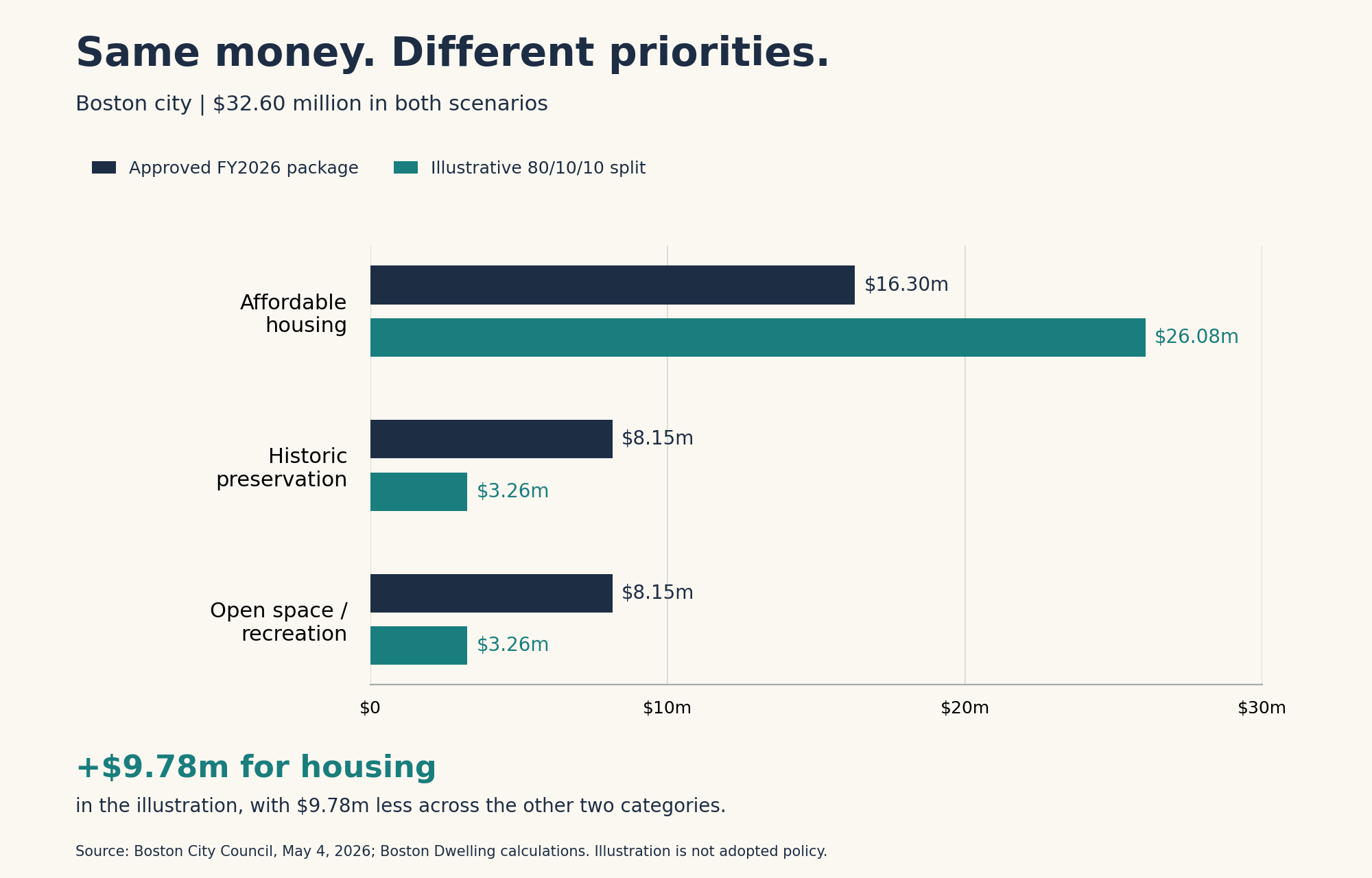
| Category | Approved FY2026 package | Illustrative 80/10/10 split |
|---|---|---|
| Affordable housing | $16.30m (50%) | $26.08m (80%) |
| Historic preservation | $8.15m (25%) | $3.26m (10%) |
| Open space / recreation | $8.15m (25%) | $3.26m (10%) |
| Total | $32.60m | $32.60m |
Boston Dwelling calculation using the approved package as a common base. The right column is hypothetical; it is not an adopted allocation or a legal-compliance calculation for annual revenues.
State law (opens in a new tab) requires communities to spend or reserve at least 10% of annual CPA revenues for each of open space, historic resources and community housing. Those minimums apply to annual revenues, which is why a project-package comparison cannot establish compliance on its own. Existing commitments and the full annual accounts still need to be considered.
The tradeoff becomes easier to see at a place such as Westland Gate, the entrance to the Back Bay Fens at Westland Avenue and Hemenway Street. Fenway Civic Association (opens in a new tab) records a $200,000 CPA award in 2018 toward the gateway project. The City’s restoration plans (opens in a new tab) included monument conservation, accessibility improvements and landscape work.
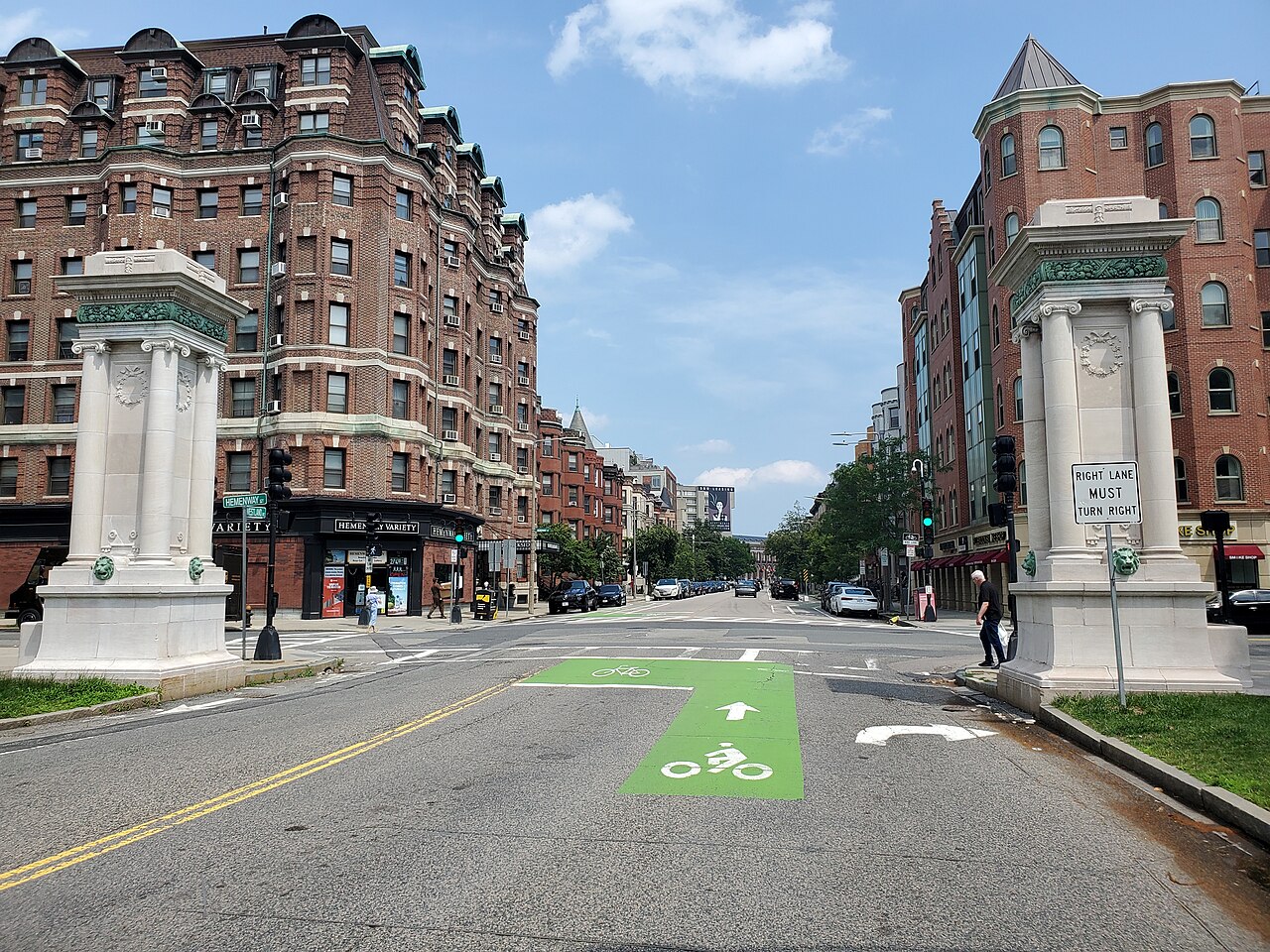
Westland Gate at the Back Bay Fens, July 6, 2021. A historical view of a CPA-supported place, not a photograph of current work. Photo: Pi.1415926535 · Source: Wikimedia Commons · CC BY-SA 4.0 · Proportionally resized to 1280 × 960; no crop or scene edits.; preview thumbnails may be cropped
For someone living nearby, an accessible park entrance can be part of the value of staying in the neighborhood. That does not settle how much housing should receive. It explains why officials should name the projects that would wait or need another source of money. This older award is an example of CPA’s reach, not a grant proposed for cancellation.
Follow the money through to a home
Boston’s April rental-housing funding announcement (opens in a new tab) shows why a larger allocation cannot be translated directly into a number of available apartments. That round combined CPA resources with other local and federal sources. It included new construction and preservation, with different buildings serving different residents.
Consider the Nate Smith House in Jamaica Plain. The City’s April announcement described preserving and modernizing 45 deeply affordable senior apartments there, including accessibility work and an elevator replacement. For a resident relying on that elevator, the benefit is being able to keep using an existing home. For an apartment hunter, those 45 homes are not 45 new openings. The announcement does not isolate CPA’s contribution to that project.
Both preserving homes and creating new ones can be worthwhile, but they answer different household needs. A useful public scorecard would separate them, show the incomes and household sizes served, and identify financing still required. Then it would report when the work is finished. That gives residents something more concrete to follow than an award announcement.
There is no sound “extra apartments” estimate to attach to the $9.78 million illustration without a verified project list and financing needs. Dividing it by a convenient average would hide those differences.
What residents can do with this debate
- Ask for a delivery plan. A larger percentage should come with named uses, affordability commitments and a way to track completion.
- Read both sides of the allocation. Ask which preservation and open-space projects would be delayed, reduced or funded another way.
- Make the household need specific. Testimony about senior housing, family-sized homes or preserving an existing affordable building helps explain what a funding priority should accomplish.
To follow the discussion, start with the official hearing notice (opens in a new tab) and City Council TV (opens in a new tab). The notice lists ryan.pratt@boston.gov for participation instructions and ccc.cpa@boston.gov for written comments; identify Docket 1601. If you want to testify, check current arrangements with committee staff. A scheduled hearing does not establish its outcome.
Have a question about how Boston pays for housing? Email Here. We’ll answer directly or explore it in a future article.