Buying a Boston condo? Who pays when the roof needs replacing?
What your monthly condo fee covers, how shared repair bills reach individual homeowners, and the questions to ask before buying.
By Boston Dwelling · Published · Updated · 6 min read
You're buying a home, but you're also joining the other owners in looking after a building. That means a shared roof can become your expense even when your condo is on the first floor. Before you fall in love with the kitchen, it's worth knowing how that bill would reach you.
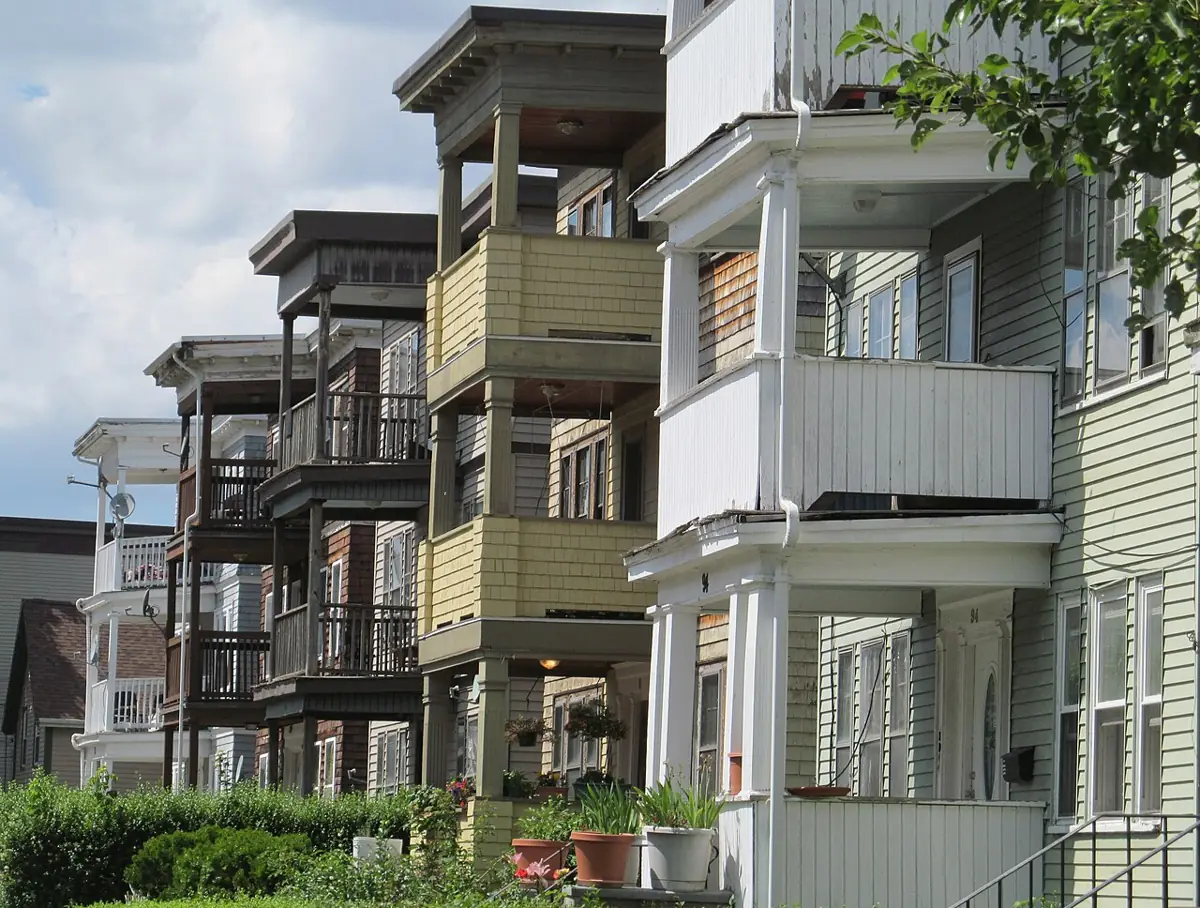
Triple-decker porches on Rosseter Street in Dorchester, photographed July 5, 2013. Photo: Pi.1415926535 · Source: Wikimedia Commons · CC BY-SA 4.0 · Resized for web; preview thumbnails may be cropped
What exactly is a condo fee?
A condo doesn't have to be in a high-rise. It can be one of a few homes in a smaller building, a townhouse or an apartment in a larger building. The important part is the ownership arrangement: your home is yours, while certain parts of the property are shared.
You own your individual unit and a share of the common areas. The condo association is the organization of the unit owners that manages shared responsibilities. It may hire a property manager, but the homeowners still fund the association's expenses.
A condo fee is your regular contribution to that shared budget, usually paid monthly. Depending on the building, it can cover shared insurance, cleaning, snow removal, maintenance, some utilities and money set aside for future repairs. Ask for the actual budget: two identical-looking fees can include different things.
The fee is generally separate from your mortgage payment. Include it alongside your mortgage, property taxes, your own insurance and other household costs when comparing homes.
Who is responsible for the roof?
Under Massachusetts condominium law, roofs generally count as common areas unless the master deed provides otherwise. The association typically arranges shared repair work, and owners fund it according to the applicable expense shares. Your unit's location does not by itself decide who pays.
Step 1: The association arranges the work
The governing documents determine how shared maintenance and repairs are handled.
Step 2: The shared budget pays the contractor
Available reserve savings or additional funding cover the project's cost.
Step 3: Individual owners fund their shares
The money comes from regular fees, prior contributions or an additional assessment.
Source: Massachusetts Legislature, Massachusetts General Laws, Chapter 183A, Section 6
Your own appliances and many finishes inside the unit are usually your responsibility. Other components can have specific rules. Have your attorney check the master deed and bylaws rather than assuming every window, pipe or deck is treated the same way.
When the shared savings don't cover the repair
A reserve fund is money set aside for future shared work. If a repair costs more than the available funds, the association may need additional funding. A special assessment is an extra charge to owners beyond the regular fee; it may be payable at once or in installments.
Here is a hypothetical three-unit building with equal expense shares. These are illustration amounts, not a Boston roofing estimate or an actual property's bill.
| Hypothetical roof replacement | Amount |
|---|---|
| Total project cost | $90,000 |
| Reserve savings available for this project | $30,000 |
| Remaining amount to fund | $60,000 |
| Additional assessment for each of three equal-share owners | $20,000 |
Author's illustrative calculation: $90,000 - $30,000 = $60,000; $60,000 / 3 = $20,000. Assumes the remaining cost is assessed entirely to three equal-share owners, with no insurance payment or association loan.
Actual expense shares need not be equal. The lesson is to compare the advertised monthly fee with the building's repair plans and savings. A low fee can be manageable today while leaving a larger bill for later. A higher fee alone does not prove that a building is well prepared.
Four checks before you buy
- Read the current budget. What does the fee cover, and how much goes toward future repairs?
- Ask about the next budget. Are a fee increase, an assessment or an association loan approved or being discussed?
- Review upcoming work. Request any reserve study, recent meeting minutes and information about major planned repairs.
- Confirm your share. Have your attorney review the governing documents and any assessment obligations, and have your lender check the building's eligibility for your loan.
A lending change worth asking about
For loan applications dated January 4, 2027, or later, Fannie Mae's Full Review process will increase its specified minimum annual replacement-reserve allocation from 10% to 15% of budgeted assessment income. This is a financing standard that can apply to Boston condo purchases, not a Massachusetts requirement that every homeowner's fee rise.
What would that mean for someone buying a $650,000 Boston condo? Consider an illustrative 30-year fixed mortgage with 20% down ($130,000), leaving a $520,000 loan at an assumed 6.5% interest rate. Principal and interest would be about $3,287 a month. Add an assumed $500 monthly condo fee, and those two costs total about $3,787 before property taxes, insurance and other expenses. These are chosen example inputs, not a current loan quote or an estimate of typical Boston condo fees. Smaller down payments are possible and change the calculation.
| Example assumption or cost | Amount |
|---|---|
| Purchase price | $650,000 |
| Down payment (20%) | $130,000 |
| Mortgage amount | $520,000 |
| Loan assumptions | 30-year fixed; assumed 6.5% interest |
| Monthly mortgage principal and interest | About $3,287 |
| Assumed monthly condo fee | $500 |
| Mortgage principal and interest plus condo fee | About $3,787/month |
Illustration only. The subtotal excludes property taxes, insurance, utilities, closing costs and special assessments. The interest rate, down payment and condo fee are assumptions, not current market averages or an offer of financing.
The reserve percentages apply to the association's annual fee income, not to your $520,000 mortgage or the home's price. To translate them into household dollars, assume every owner contributes the same $500 monthly fee, the entire amount counts in the reserve calculation and there are no excluded income items. At a 10% allocation, the equivalent of $50 of each owner's monthly contribution goes into reserves. At 15%, it is $75. That is $25 more directed to shared repair savings each month, or $300 a year, within this simplified example.
From a hypothetical $500 condo fee: $50 versus $75 for reserves
Illustrative Boston condo household; applicable U.S. Fannie Mae Full Review standard · Observed Hypothetical budget; January 4, 2027 application-date trigger · Values in US dollars
At 10% of the assumed fee income
At 15% of the same assumed fee income
Show the exact values
| Category | Value |
|---|---|
| At 10% of the assumed fee income | $50 |
| At 15% of the same assumed fee income | $75 |
Author's illustration using Fannie Mae's standards: $500 × 10% = $50; $500 × 15% = $75. These amounts are part of the assumed $500 fee, not added to the mortgage. The rule applies at association level. It does not require every owner's fee to rise by $25. Actual budgets, expense shares, permitted exclusions and an acceptable reserve study can change the result.
Source: Fannie Mae, Lender Letter LL-2026-03 (March 18, 2026; checked October 11, 2026)
This does not automatically make the condo fee $525. The association might already save enough, reallocate its budget or need to collect more to meet both operating costs and repair savings. The mortgage principal-and-interest payment does not change because of this reserve standard. Ask about the building's actual budget rather than applying the percentages to your loan.
Some smaller projects may qualify for a review waiver; lenders can also use an acceptable reserve study subject to the rules. Ask which route applies to your building and loan. The broader repair-budget question matters even when this particular standard does not.
What to bring to your next condo showing
- Budget for the condo fee as well as the mortgage, and check what that fee actually includes.
- Understand your share of shared repairs before buying. The association organizes the work, but owners fund it.
- Request repair plans, reserve information and assessment details. A comfortable monthly fee is only part of the cost of ownership.