Boston keeps adding affordable housing. Why is it still so hard to get?
The shortage is real. But the rent, the income rules and the wait matter as much as the word "affordable."
By Boston Dwelling · Published · 5 min read
If your lease is coming up for renewal, “new affordable apartments” sounds promising. But you still need to know what the home costs, whether you qualify, and whether it will be ready before you need to move.
The difficulty is that “affordable housing” covers homes with different rents, income rules and application routes. A building can add useful housing without offering a rent that works for your household. A renovation can protect existing residents without creating a single opening. Understanding that difference makes the next announcement easier to read, and your next application easier to judge.
The shortage behind the search
The National Low Income Housing Coalition’s 2026 Gap report (opens in a new tab), using 2024 Census data, finds roughly 47 affordable and available rental homes for every 100 extremely low-income renter households in the Boston-Cambridge-Newton metro area, including its New Hampshire portion.
At the lowest incomes, supply falls far short
Boston-Cambridge-Newton, MA-NH metro · Observed 2024 Census ACS data; NLIHC analysis published March 2026 · Values in
Extremely low-income renter households
Affordable and available rental homes
Show the exact values
| Category | Value |
|---|---|
| Extremely low-income renter households | 213,113 |
| Affordable and available rental homes | 99,339 |
213,113 extremely low-income renter households; 99,339 affordable and available rental homes. Estimated gap: 113,774. These are stock estimates, not current vacancies. Roughly 47 affordable and available rental homes for every 100 extremely low-income renter households.
Source: NLIHC, Massachusetts data table, including Boston metro
“Extremely low-income” means income at or below the higher of the federal poverty guideline or 30% of area median income (AMI). In this analysis, “available” includes homes already occupied by that income group; it excludes affordable homes occupied by higher-income households. This is a measure of the housing stock, not a list of vacant apartments.
For someone searching, the important point is the imbalance: far more households need these homes than the measured supply can serve. The report does not tell you how many people are applying for a particular apartment or how long you will wait. It does help explain why meeting the income rules can still leave you without a home you can secure.
Why an announcement may not mean an opening
The supply picture also explains why it matters to distinguish adding homes from protecting them. On October 14, officials announced more than $16 million for Fairmount Apartments in Hyde Park (opens in a new tab). The Boston Housing Authority (BHA) says initial work will include interior improvements, accessibility upgrades, electric heating and hot water, and cooling. This is a modernization initiative, rather than an announcement of hundreds of new vacancies.
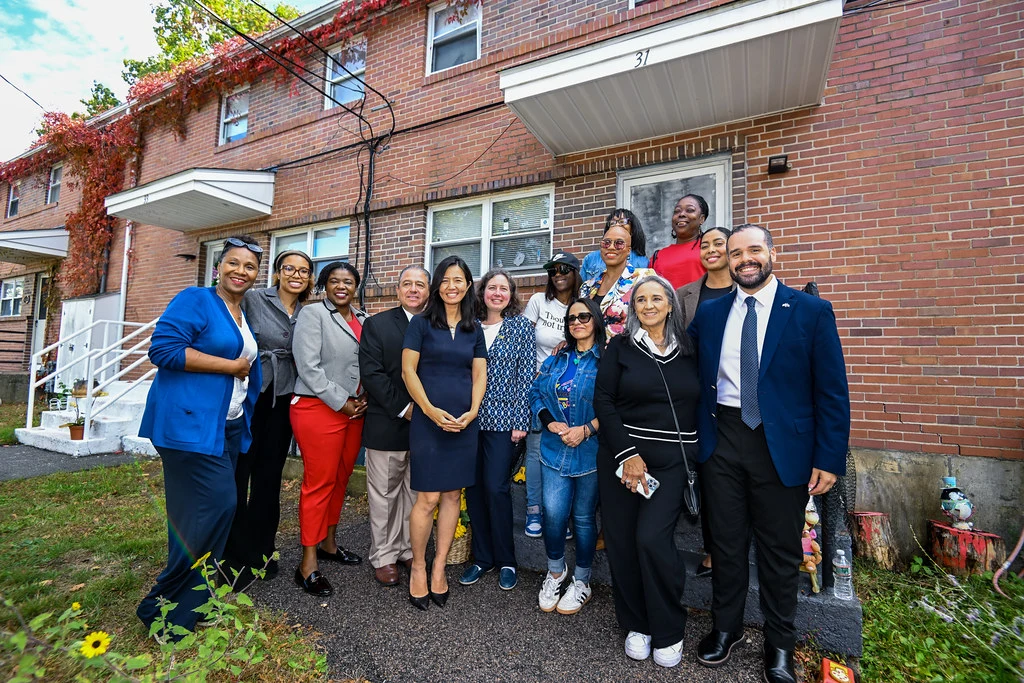
Fairmount public-housing modernization announcement, Hyde Park, October 14, 2026. Photo: Isabel Leon. Photo courtesy of City of Boston Mayor’s Office · Source: City of Boston Mayor’s Office · Noncommercial use with attribution; City of Boston Mayor’s Office terms · Converted to WebP; displayed proportionally; no crop or other edits. No implied endorsement.; preview thumbnails may be cropped
In GBH’s October 14 coverage (opens in a new tab), Fairmount resident Wendy Rosseau described the safety she feels in her community. That is her experience, shared at the announcement, and a reminder that a home’s value reaches beyond the rent.
That is a reason to care about repairs even when they don’t create an extra apartment. An affordable home can let someone keep a neighborhood, familiar faces and routines. The question is both how we make room for people looking for a home and how we protect the homes people already rely on.
Then ask: affordable for my household?
Once you find an opportunity accepting applications, the next question is whether its rent fits your budget. That is where the broad word “affordable” needs a closer look. The income needed to qualify and the amount you can comfortably pay are two separate checks.
Boston’s income-restricted housing guide (opens in a new tab) sets eligibility using household size, combined income and a percentage of area median income, or AMI. Its table, updated September 28, lists one-person limits of $36,000 at 30% AMI and $96,000 at 80% AMI. Programs can use different limits. Those are very different budgets.
Take a hypothetical household earning $30,000 before taxes. At the common 30% affordability benchmark, it has $750 a month for rent and utilities. A $1,200 apartment would absorb 48% of that income before any extra utility bills. A below-market price can still leave that household stretched. That leaves $1,300 a month from gross income for everything else, including taxes, food, transportation and other bills. The example is hypothetical; the point is to compare a specific rent with your own income, rather than assume a restricted apartment will automatically fit.
Ask whether the advertised rent is fixed for the apartment or calculated from your household’s income, and which utilities you pay. An income ceiling tells you who may apply; it doesn’t tell you what your own monthly bill will be.
Before you apply, get these answers
A workable rent brings you to the third question: how do you actually get the apartment? For a City housing lottery, your lottery number is not your final ranking (opens in a new tab). Preferences affect the order, and selection is followed by screening and certification. Being asked for documents is progress; it is not the same as having a signed lease.
| Ask the property manager | Why it matters |
|---|---|
| Is this a vacancy, a lottery, or a waitlist for future openings? | Match the opportunity to your moving date. |
| What would I pay each month, including tenant-paid utilities? | Compare the actual bill with your own budget. |
| If selected, what documents are required, and when? | Prepare income, household and asset records before a short deadline. |
Reader checklist based on Boston’s income-restricted housing and Metrolist application guidance. Ask for the property-specific answer in writing.
Check your household’s fit. Review the income, assets, household size and bedroom rules for that particular home.
Use more than one application route. Metrolist (opens in a new tab) covers income-restricted opportunities. CHAMP (opens in a new tab) handles state-aided public housing and state-funded vouchers. For federal programs, check the relevant housing agency; BHA explains its application process here (opens in a new tab).
Treat a waitlist as a longer-term option. Keep your contact details current and a separate plan for your next lease. Eligibility does not guarantee immediate assistance.
If you have to decide about renewing your lease soon, keep that deadline alongside the application dates. Ask the listing agent what is known about timing and what remains uncertain. That gives you a clearer basis for planning than either giving up because the system looks confusing or counting on an apartment before an offer is confirmed.
Have a question about affordable housing in Greater Boston? Email Here. We’ll answer directly or explore it in a future article.